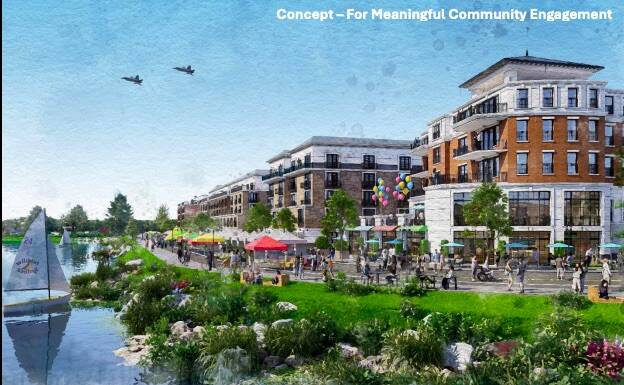
The city of Oak Harbor now has a new blueprint for redeveloping and revitalizing the downtown waterfront district.
Last week, the city council adopted the “Oak Harbor Vision to Action Planning Document,” which was created by consultant Center for Creative Land Recycling following three public workshops and a series of polls and surveys to gauge the visions, interests and concerns of residents.
The resolution points out that the city has adopted many plans for the waterfront and Pioneer Way area over the years, which shows that people deem it as a high priority even as implementation of the plans has faltered. The resolution notes the 1990 Harbor Watch document, but similar plans go back as far the early 1970s when the chamber of commerce envisioned a conference center on the water, according to Whidbey News-Times stories.
The resolution resolves that the city is committed to redeveloping the downtown and Waterfront District, which is 121 acres of land that encompasses hundreds of businesses and homes. It states that the staff will monitor and periodically report on the progress toward the goal.
The plan is part of a three-step effort that started with the city’s investigation, study and purchase of two properties at the intersection of Pioneer Way and Bayshore Drive. The city is using grant funds to clean legacy contamination on the property before working with a developer to “reuse” the parcels.
The city worked with an architectural firm to create integrated planning and renderings for downtown. Finally, the city worked with Center for Creative Land Recycling to create the Vision to Action Plan. All three efforts were funded by grants obtained by city staff.
On Tuesday, consultant Norman Wright and Public Works Director Steve Schuller updated the council on the status of the plan, which the council unanimously approved.
Oak Harbor is predicted to receive 13,000 new residents over the next 20 years, Wright said. According to a staff report about the agenda bill, over the next calendar year, the city will be creating an infrastructure plan for the next 100 years to accommodate the new residents.
Council members noted their approval.
“It’s our responsibility to plan for the future,” Councilmember Eric Marshall said.
Wright explained that the majority of participants in the workshops agreed that Oak Harbor will need to make major policy changes and infrastructure improvements to support this level of growth. They also expressed that it would be worthwhile for the waterfront to be developed to reduce growth pressure in other parts of town and increase reinvestment.
“People saw how the waterfront, through the vision that’s been refined over this plan, could be a cornerstone to the sustainable development that’s going to be needed over these next 20 years of change and growth,” Wright said.
Additionally, participants looked at models to learn where the waterfront area would develop over time and how that development would create impacts, from trips it would generate, to jobs it would create, to housing that would be necessary for the new residents.
At a workshop, residents also expressed their top three priorities for the city — walkable streets, vibrant public plazas and live-play-work activity areas.
The vision to action plan intends to deliver on those top three priorities as quickly as possible, Wright said.
“There was enough support to make this a responsive plan that reflected the general sentiment from the community,” Wright said.
Councilmember James Marrow said the plan is a good starting point, but he noted that property owners have the final say on what they are going to be doing with their property. In response, Wright explained there are certain incentives that will help the city be confident in developing investments that will induce others to get on board.
Schuller invited interested residents to come to planning commission meetings to provide their input as the plan continues to develop.