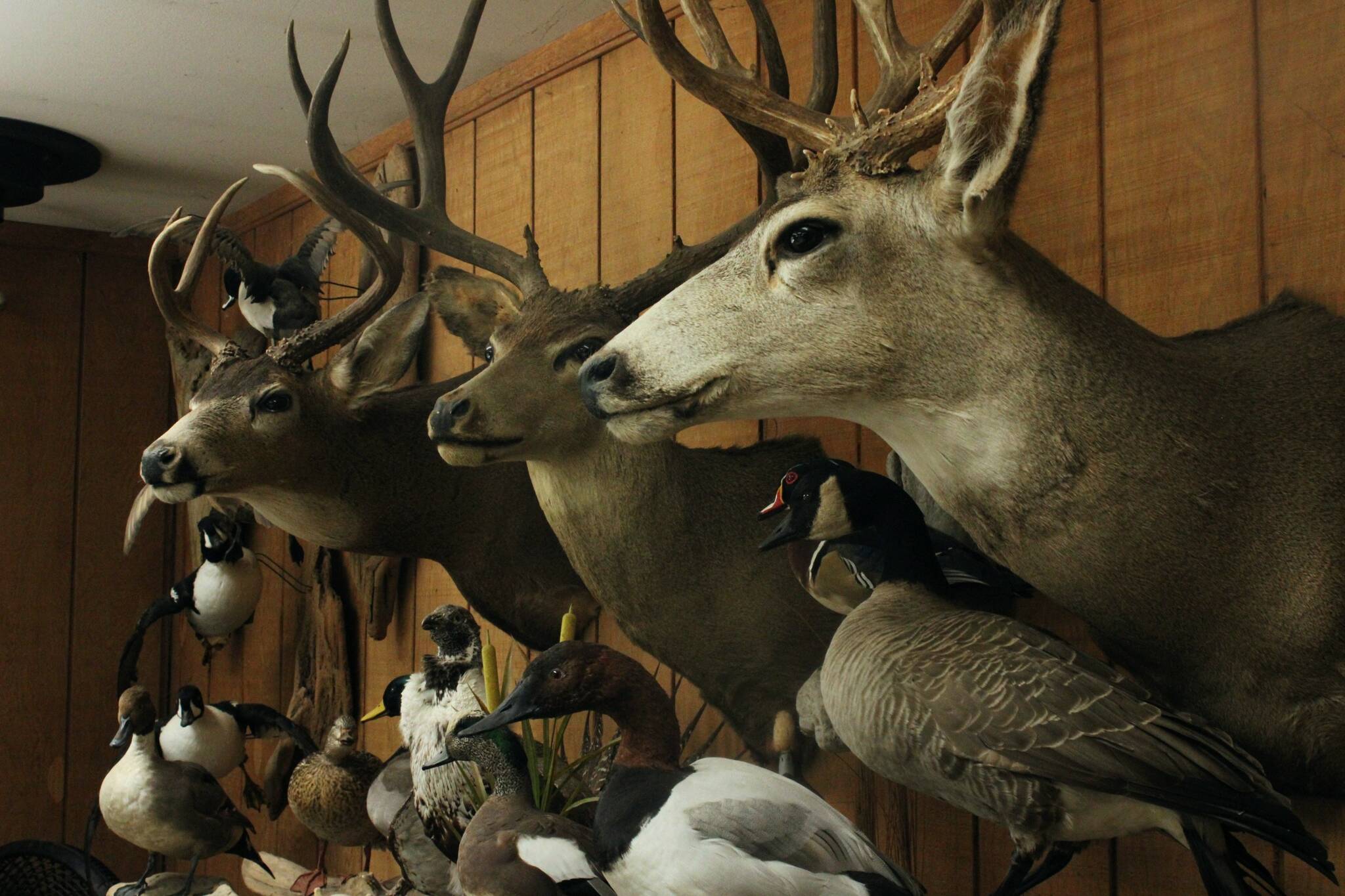
A hundred eyes, unblinking, watching the slow dismantling of a bear hide at the hands of a rather unlikely hero.
That is how the News-Times found Emily “Em” Houser, the 26-year-old apprentice of longtime taxidermist Matt Klope, owner of Whidbey Island Taxidermy.
Houser spends three days a week — sometimes more — learning how to mount animals at the only taxidermy business on the island. Despite having studied under Klope for just the last two years, the industry veteran is sure of the potential hunched over a giant paw, meticulously running a scalpel around its pads.
Demand for taxidermy in Washington may be overwhelming the industry’s ability to supply it, and with every carcass Houser resurrects, she is part of the effort to revive what Klope calls a “dying art” in the state.
“Everyone’s retiring, dying or moving,” he said.
Death is an enduring fascination of Houser’s. As a kid in Terre Haute, Indiana, she picked up dead squirrels and accumulated a personal collection of skulls and teeth. Things are no different now. Houser’s home is inhabited by plenty of taxidermied animals, and she sharpened knives for volunteers at the gray whale dissection on the beach near YMCA Camp Casey this summer.
Houser moved to the island three years ago. She met Klope while attending one of the Whidbey Audubon Society’s regular stick bird taxidermy sessions at Whidbey Island Taxidermy. There, surrounded by birds frozen in flight and jars of eyeballs and tongues, an opportunity presented itself to finally learn taxidermy the way she had always longed to.
“I have always found taxidermy to be the biggest form of flattery for the animal that lost its life,” Houser said. “And being able to bring that animal back to its natural glory, or as close as you can get to its natural glory, is really important.”
What caught Klope’s eye about Houser, initially, were her painting skills. And once she began apprenticing, her sculpting aptitude stunned him. Turns out, she studied animation and sculpting at Ball State University in Indiana.
“A lot of that stuff was a good artistic backbone for what I’m able to do now,” Houser said.
Probing inside animals has given her an entirely new anatomical perspective on the creatures she only used to draw. But for all the romanticism she can afford her craft, Houser is duly aware of the morbidity.
“You have to love it,” she said. “You are playing (with) and manipulating a dead thing to make it into something that seems alive again.”
Like his apprentice, dead animals fascinated Klope during childhood; he tagged along on his dad’s quail and dove hunting endeavors as a 9-year-old. Unlike his apprentice, he is self-taught and spent free time in school ripping apart — then reconstructing — carcasses. Since opening Whidbey Island Taxidermy in 1989, the delicate art of mounting fragile carcasses of waterfowl and other birds has become Klope’s specialty.
“You have to skin it very carefully,” he said. “It would be like skinning a wet paper towel.”
When preparing a bird to mount, Klope cuts the carcass from the neck to the cloaca, a large enough incision to slip the body out of. Slits are made at the knees and wings as well, and another on the back of the neck through which to remove the skull, brain and eyes. Fat clings to the skin when removed from the body, and must be carefully excised.
The skin — feathered, eyeless and limp — is then washed and dried to restore the feathers’ “pop,” Klope explained.
Klope measures the animals’ bodies to create forms which the skin is adhered to. Clay is molded to the form to create depth, mimic the ridges of meat rippling underneath skin. Once the form is dressed, the skin is sewn closed and finishing touches are painted on the bills and feet.
Ducks are speedy at this point in Klope’s career, taking just eight hours to mount. At that rate, he can mount more than 100 in a year. Having an apprentice ensures the process runs even smoother, especially one as skilled as Houser — and one he feels as connected to, likening her to a daughter.
Houser feels a similar sense of belonging.
“It’s family,” she said, asked what her mentorship with Klope has given her. “It’s a place to be where I feel accepted.”
Only those intending to practice commercial taxidermy require a license in Washington. In 2025, according to Communications Manager Chase Gunnell, the Washington State Department of Fish and Wildlife licensed 153 taxidermists.
That number is not the full story. Year-to-year licensing data was unavailable from the department, and information about active taxidermists hard to find otherwise, reflective of a larger connectivity issue affecting Washington’s taxidermists.
“I don’t know where taxidermists are anymore. I mean, you can look them up on the internet, but you only get pieces of information. So I don’t know who’s left,” Klope said. “It’s kind of this black hole.”
There is no Washington-specific taxidermy association today, and what was the Northwestern Taxidermists Association disbanded around 2005, according to Klope.
Colt Ford, president of the National Taxidermy Association and co-owner of Ford Taxidermy in Nashville, Georgia, said state associations are important in keeping taxidermists connected, educating them and ensuring the art itself “progresses,” although they are not affiliated with the national association. State associations typically hold conventions to satisfy these goals, wherein taxidermists can attend seminars, network and enter competitions, he added.
“If you don’t have that association, you’re not able to learn everything that’s brand-new in our industry and constantly evolve your business,” he said. “You’re kind of stuck.”
Dedicated taxidermy schools can be found in states like Texas, Montana and Iowa, Ford added. The Mountain Valley School of Taxidermy, located in Kent, shuttered in 2007. Aside from conventions and schools, new taxidermists can learn the trade through books and online tutorials, or by apprenticing.
Generally, taxidermy is of a greater popularity on the East Coast, in the Midwest and in the South; Ford pointed to Georgia, Pennsylvania, Texas, Wisconsin and North Carolina as fitting examples.
As several taxidermists stressed, the relationship between taxidermy and hunting is symbiotic. Commercial taxidermy largely serves as a way for hunters to preserve quarries with sentimental value, like a loved one’s first or last catch.
Although taxidermists voiced their frustrations regarding hunting regulations in Washington — that hunting sites can be overcrowded, that hunting license fees increased by 38% in July according to the Washington State Department of Fish and Wildlife — hunting may not be as culturally significant as it is in states where taxidermy is much larger.
“Washington State does have a lot of recreational people, and we do like to go out and hunt and fish,” Diane Brazier of Brazier Taxidermy in Ravensdale said. “It’s more of a recreation than a lifestyle.”
Regardless, established taxidermists in Washington do not suffer from idle hands.
Taxidermists accept an onslaught of new projects in the fall, when hunting season opens, as carcasses can only be stored for so long without rotting or sustaining freezer burn. Further, Brazier explained that projects received at this time are the “money makers,” whereas those received throughout the year tend to be smaller or artistic.
Years-long backlogs of projects are normal, Ford said, admitting he is two years behind on work himself. But he suggested backlogs “could signal a lack of quality taxidermists” in Washington.
Micheal White of Nature’s Way Taxidermy in Spanaway is dealing with his own backlog of two-and-a-half years. Rick Matthes of Cedar River Taxidermy in Enumclaw said over the last three years, he turned away a “tremendous” amount of work to stay on top of things.
“Keeping up with the volume of work is nearly impossible without quality help,” Matthes said.
Fred Peters, co-owner of Peter’s Taxidermy with his wife in Graham, corroborated this. That he refuses to accept more than a year’s worth of work at a time is irrelevant. There are “not enough workers to go around in this business,” he said.
Peters echoed Klope’s concern that taxidermy is “dying out” in Washington — the state may lack taxidermists able to supply overwhelming demand because bringing in new blood is difficult.
A living can be made mounting animals but only once a taxidermist develops a clientele, which can take time. Opening a business at the right time of year in a seasonal industry is crucial, not to mention opening a business at all can be a daunting financial undertaking. Brazier wondered if those challenges could scare new taxidermists off.
“There’s more demand than suppliers,” Brazier said. “We need more people coming into it to relieve our stress and our pressures, but a new person is definitely going to have a startup period.”
Chances are, many of those new faces will be women. Taxidermy was, historically, a male-dominated industry, but several taxidermists attested to seeing increasingly more female taxidermists over the last decade.
Women working in taxidermy were virtually unheard of when Klope started out. Now, he knows more women in the industry than men. Why this is the case is difficult to say.
Taxidermy is a slow process, ill-fitting for those in search of instant gratification, which cannot be created with machines, at least right now. Katie Turner, an apprentice of Brazier’s, guessed the time-consuming nature of the practice could deter some young people from pursuing it, and Brazier added she had seen young men in particular struggle with the tediousness of the job.
Klope thinks women succeed when it comes to the “finesse” required of certain mounts, like fragile birds, because their fingers are smaller.
Houser pointed out that more of a general acceptance of women in certain industries, as well as taxidermy as an art form, could be responsible.
Whatever the case — and whatever the state of the industry — Klope is steadfast in his belief a successful career awaits Houser. Her virtuosity speaks for itself.
“Em will be phenomenal,” he said. “She will be award-winning.”
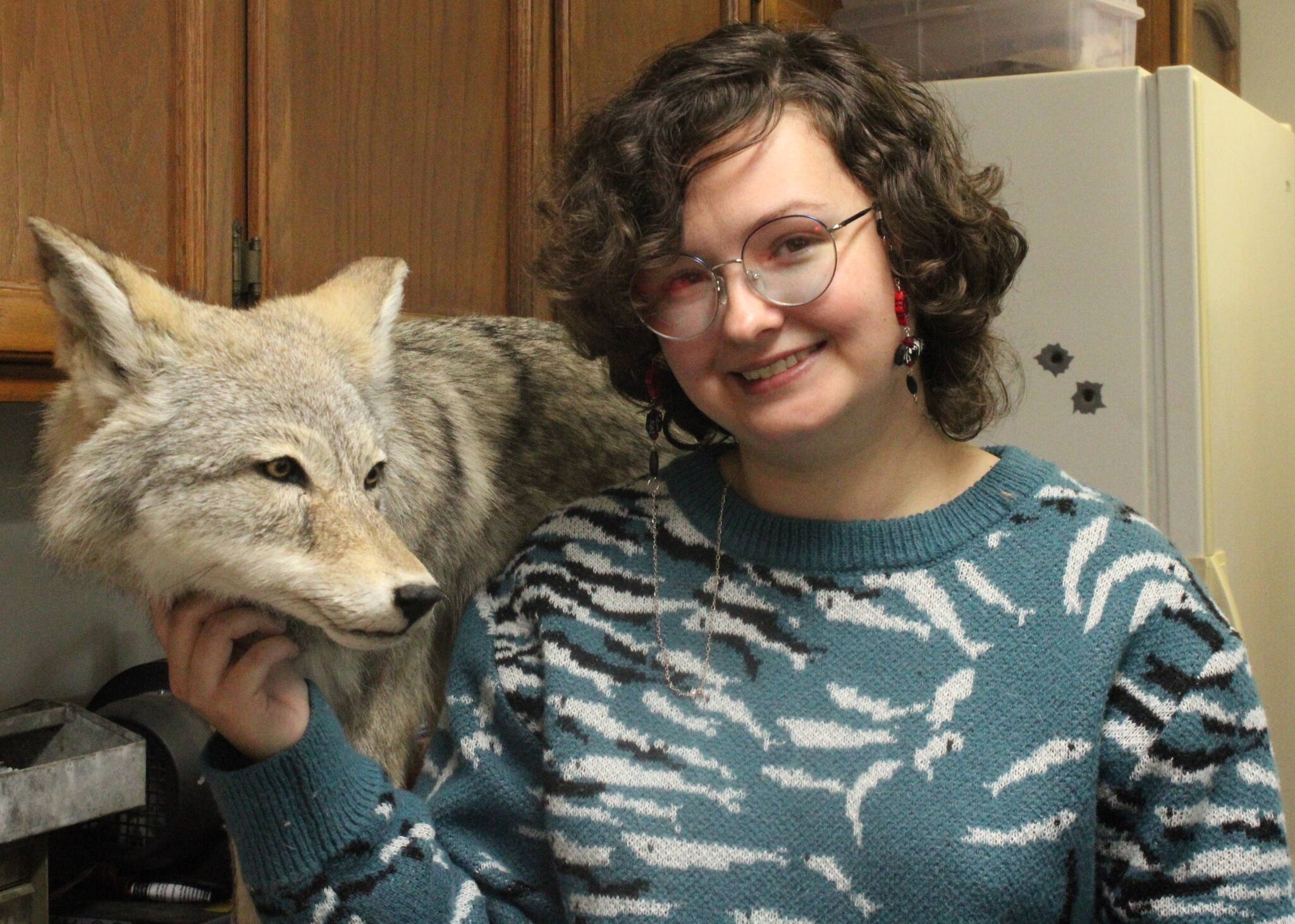
Houser is learning how to mount mammals like this coyote, which will be displayed at the Island County Historical Museum in Coupeville. (Photo by Allyson Ballard)
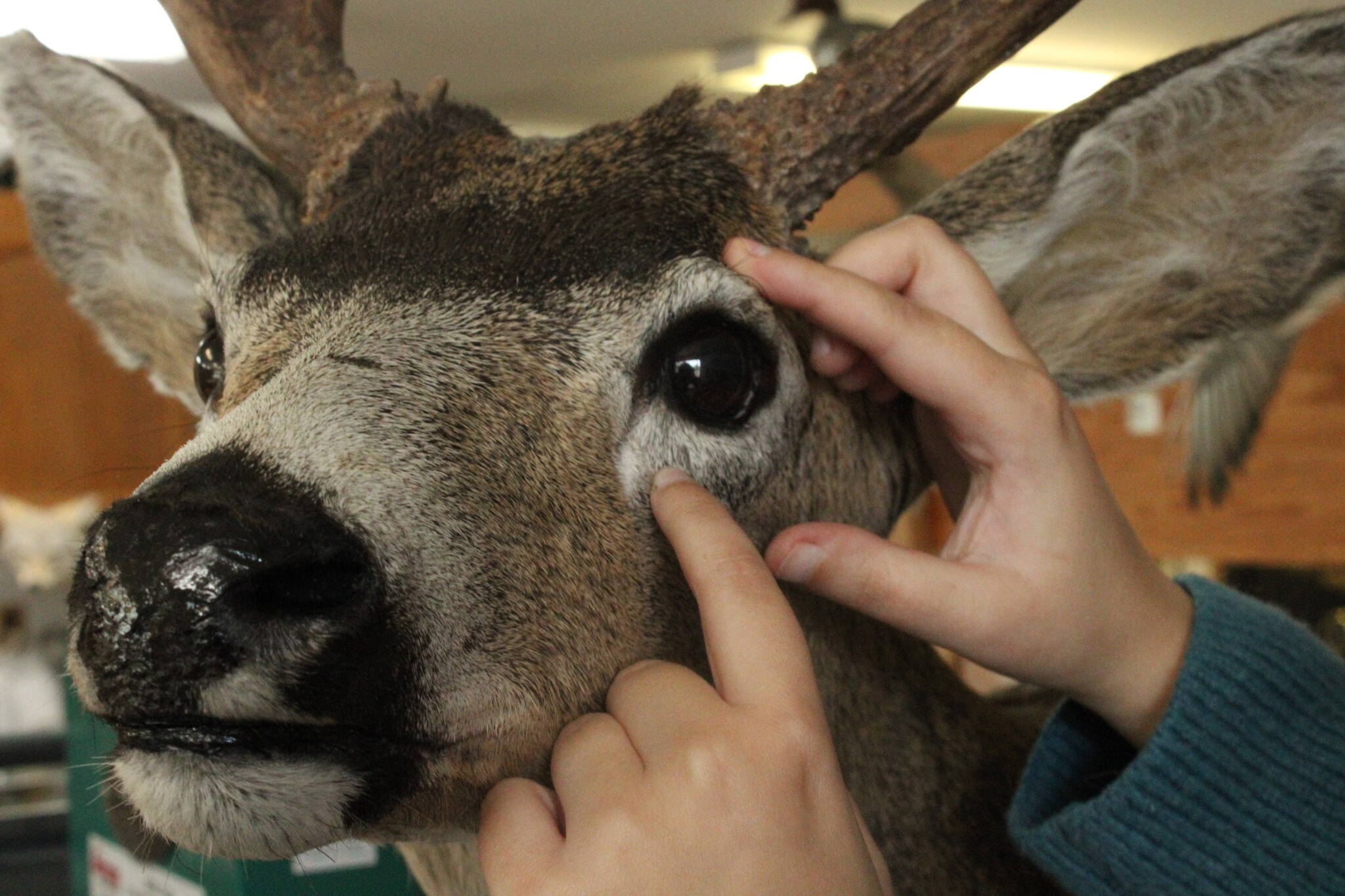
Houser explained that clay must be added to forms to give them depth, like around the eyes, mimicking the presence of bones and meat underneath skin. (Photo by Allyson Ballard)
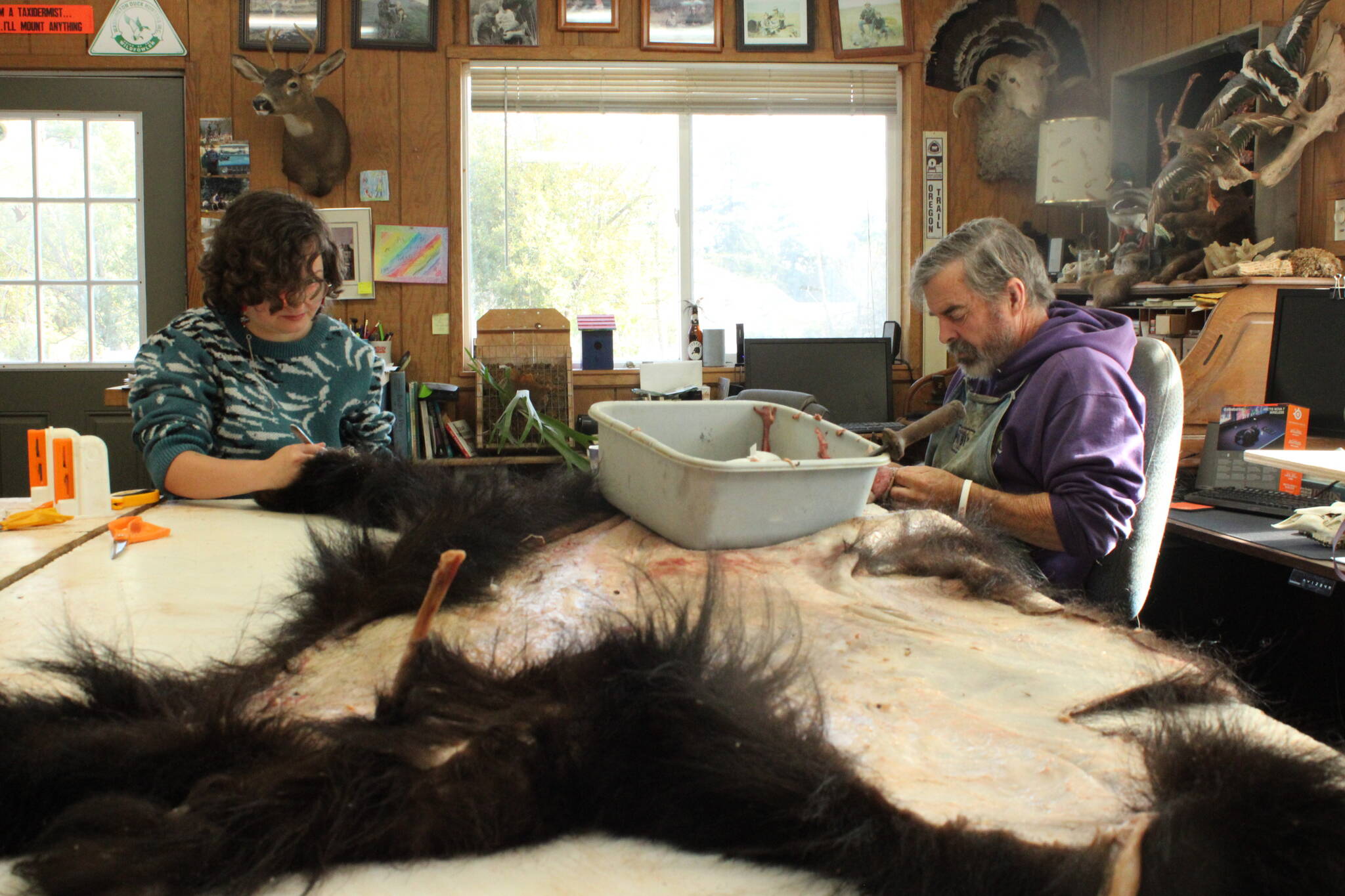
Matt Klope and his apprentice, Emily Houser, revive the dead at Whidbey Island Taxidermy. (Photo by Allyson Ballard)
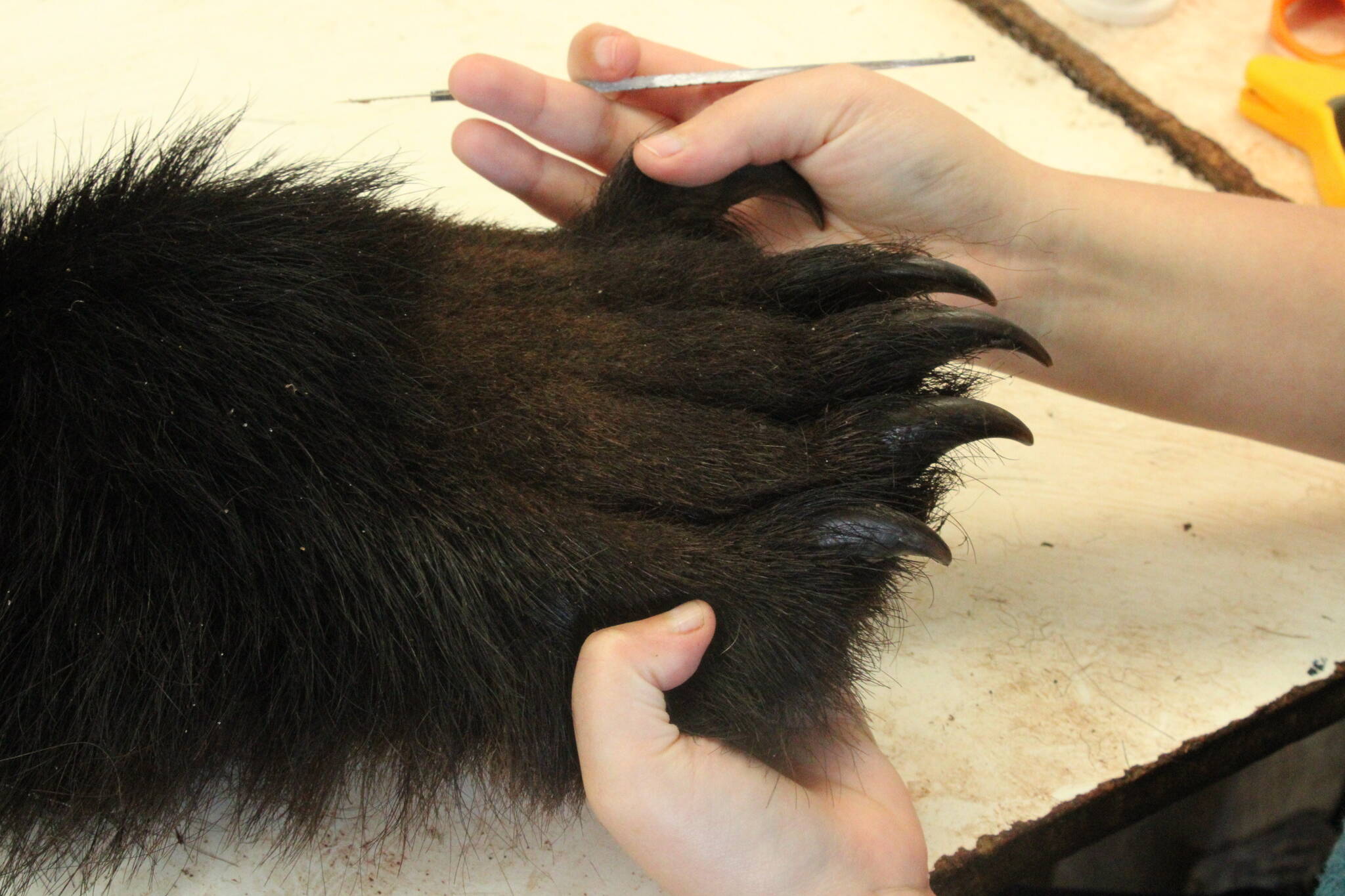
Before carcasses can be mounted, they must be cleaned extensively so as to prevent decay. (Photo by Allyson Ballard)
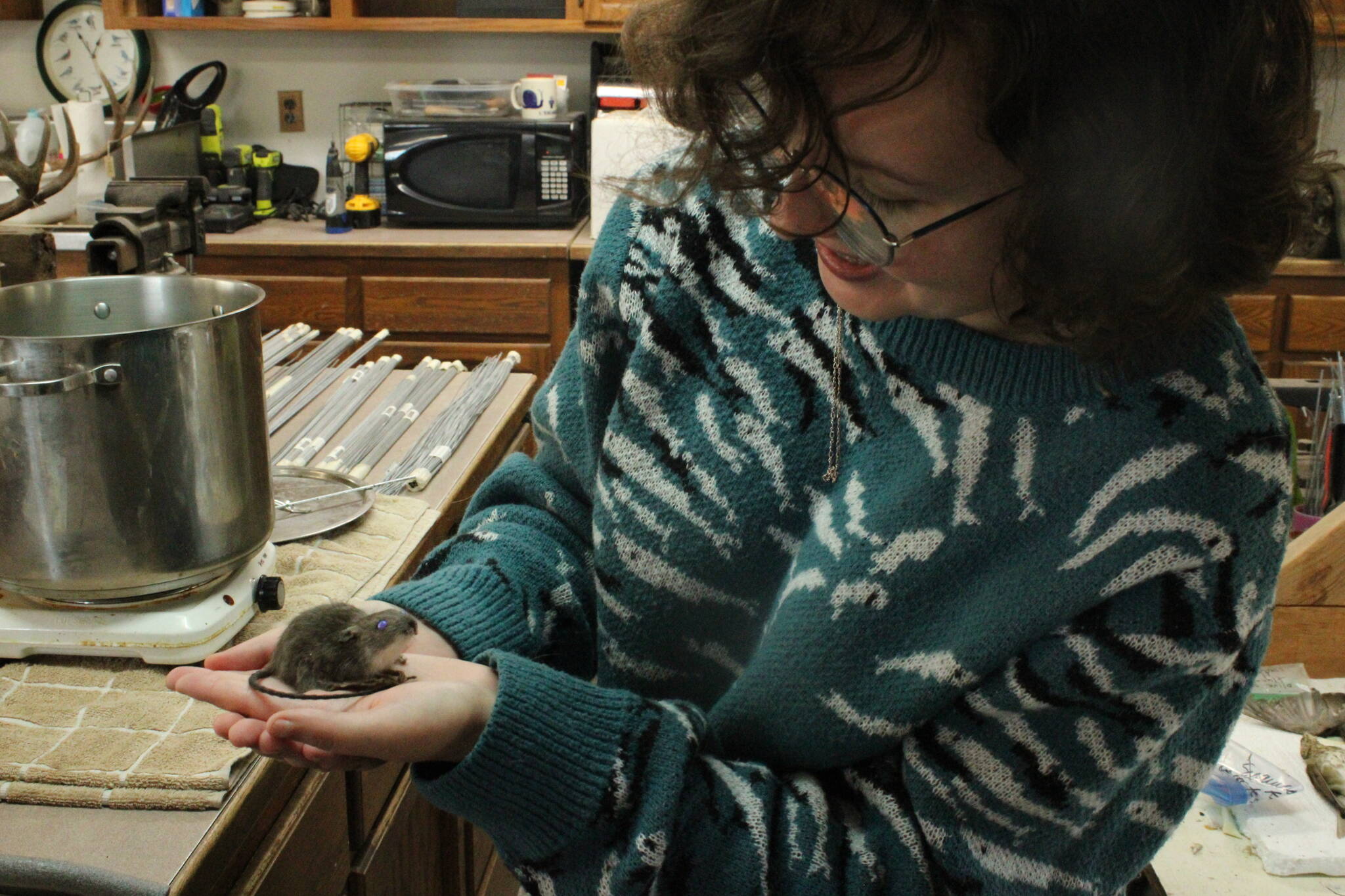
Learning taxidermy takes commitment, Houser said, but is useful for educational purposes and can be a way to honor dead animals. (Photo by Allyson Ballard)