From Point No Point to Deception Pass: Life on Whidbey is a rich tapestry of humanity
Published 1:30 am Saturday, August 30, 2025

The Goose Grocer recently announced an essay contest on the theme of Whidbey community. They wanted an essay of 300 words or less. As usual I found it impossible to express my thoughts in much less than 800. So here it is for the paper:
Whidbey Island is a green palette upon which a multitude of artists, artisans and crafters have practiced their trade over the decades and centuries. For thousands of years the human community was knit together by a native tradition of craft and rituals and songs and stories. In Langley this tradition is carried on today by an annual encampment of members of the Blue Heron Canoe family. They come every year now to remind us of their people’s homes and traditions that once flourished here. The colors and the figures of their traditional art and craft are inspired by the surrounding nature, the whales, the ravens, the forests, mountains and sea, and include the many fine ways that the native plants can be crafted, or woven into baskets, shaped into canoes, soup bowls, houses and the like. And the Blue Heron Canoe family, along with thousands of other families in native communities all along our coasts and Salish Sea, continue finding their way, redefining themselves in a complex modern world.
Nowadays artists come from all over the world and bring their own rich traditions that inform work inspired by the island environment. Community here today is no longer so dominated by one or another set of traditional ways. It is a tapestry of influences from around the world that are often interwoven to create something new and vibrant.
On a typical summer day, a resident or guest has a variety of pleasant options to choose from. Community is celebrated here in a multitude of varied cultural events. There are plays and musicals and concerts happening almost on a daily basis somewhere in our community. There are songs and rhythms from Africa, Asia, the Middle East, Latin America and European cultures.
For every event intended for local amusement there are three dedicated to raising funds or awareness of local or worldwide needs. Nonprofit service organizations of every description thrive here. They bolster a small army of volunteers that work with an equally dedicated force of paid public servants involved in fire, police, health and other valued services.
Not that we all coexist without friction. Competition is inevitable. So is comparison. So is critique. What is remarkable is the ability of the vast majority of us to tolerate and even manage so often to celebrate our differences here. If this does not always amuse everyone, no matter, they are still invited to the feast or fest.
My own favorite group of locals, the organic farmers and gardeners of South Whidbey Tilth, hold an outdoor banquet on their 11 acres at Thompson Road and the highway every August. In 2016 I marked that event with the following little speech about community:
It is easy at times to despair at things going on in a larger world that will always be mostly beyond our control. But right now, today, here we are, gathered for a community banquet under a beautiful Whidbey Island sky on a warm August evening on the South Whidbey Tilth land.
Thirty four years now since the first South Whidbey Tilth get together, our founding meeting. Members still get together for potluck suppers in member living rooms. (Most often now in winter to watch and discuss food and farming related films).
But we also have this our food and farming center nowadays, where we are gathered today. As you look around you today you see a place where plants and animals and people coexist in relative harmony in an interdependent community. People grow, sell and share food here. They also share knowledge of all kinds and grow a sense of community in the process.
As you look around you today you will see many of the people who actively participate in this center – community gardeners, teachers of classes on seed saving, weed control, plant propagation, soil building, horticulture, and the like. And you see local farmers and gardeners, crafters and food vendors, volunteer helpers and our first intern.
You will also see people, plants and animals, fruit trees and nut trees, an oak meadow, gardens, birds and other wildlife coexisting in an environment where the soil and water and air are not being poisoned and portions of the land are reserved for wild, native plant and animal habitat.
This is the harmony, the peaceable kingdom we seek to be part of. It is already ours today, if never completely realized. And you are all part of this creation.
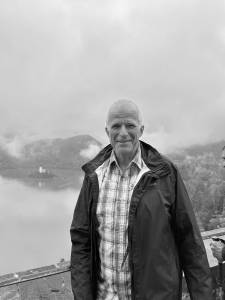
Dr. Michael Seraphinoff is a Whidbey Island resident, a former professor at Skagit Valley College and academic consultant to the International Baccalaureate Organization.