
Although the city is named after the Garry oak trees that once lined the bay, has a unique oak protection code and was honored as a “Tree City USA,” Oak Harbor has a lower “tree equity” score than other communities on Whidbey Island, according to a new online tool created by the nonprofit group American Forests.
In the city of Langley, where the cutting down of trees recently caused a controversy, the tree equity score is nearly perfect while Coupeville’s score is between that of Oak Harbor and Langley.
The creation of the tree equity score website, treeequityscore.org, has garnered media attention nationwide. A tree equity score measures how well “the benefits of trees are reaching communities living on low incomes, communities of color and others disproportionately impacted by extreme heat and other environmental hazards” and the website has tools to help communities create data-driven plans to improve tree equity, according to the website.
Tree equity scores range from 0-100 and are calculated on the neighborhood level based on Census block groups. A score of 100 means a neighborhood has enough trees.
Oak Harbor has an overall score of 72 while Coupeville’s score is 82. Langley has a score of 98, Freeland’s score is 97 and Clinton’s score is 89. Whidbey Island Naval Air Station, with its multiple runways, has a tree equity score of 64.
Laura Renninger, the president of the Oak Harbor Garry Oak Society, said the members of the group are not surprised by the city’s score, given the large swaths of Oak Harbor’s urban forest that have been logged in the last three years for development.
“In each case, the landscape suffers from tree destruction and citizens will suffer eventually with a less healthy environment,” she said in an email. “There is no way to truly mitigate this massive tree loss even if each housing project squeezes in as many trees as possible.”
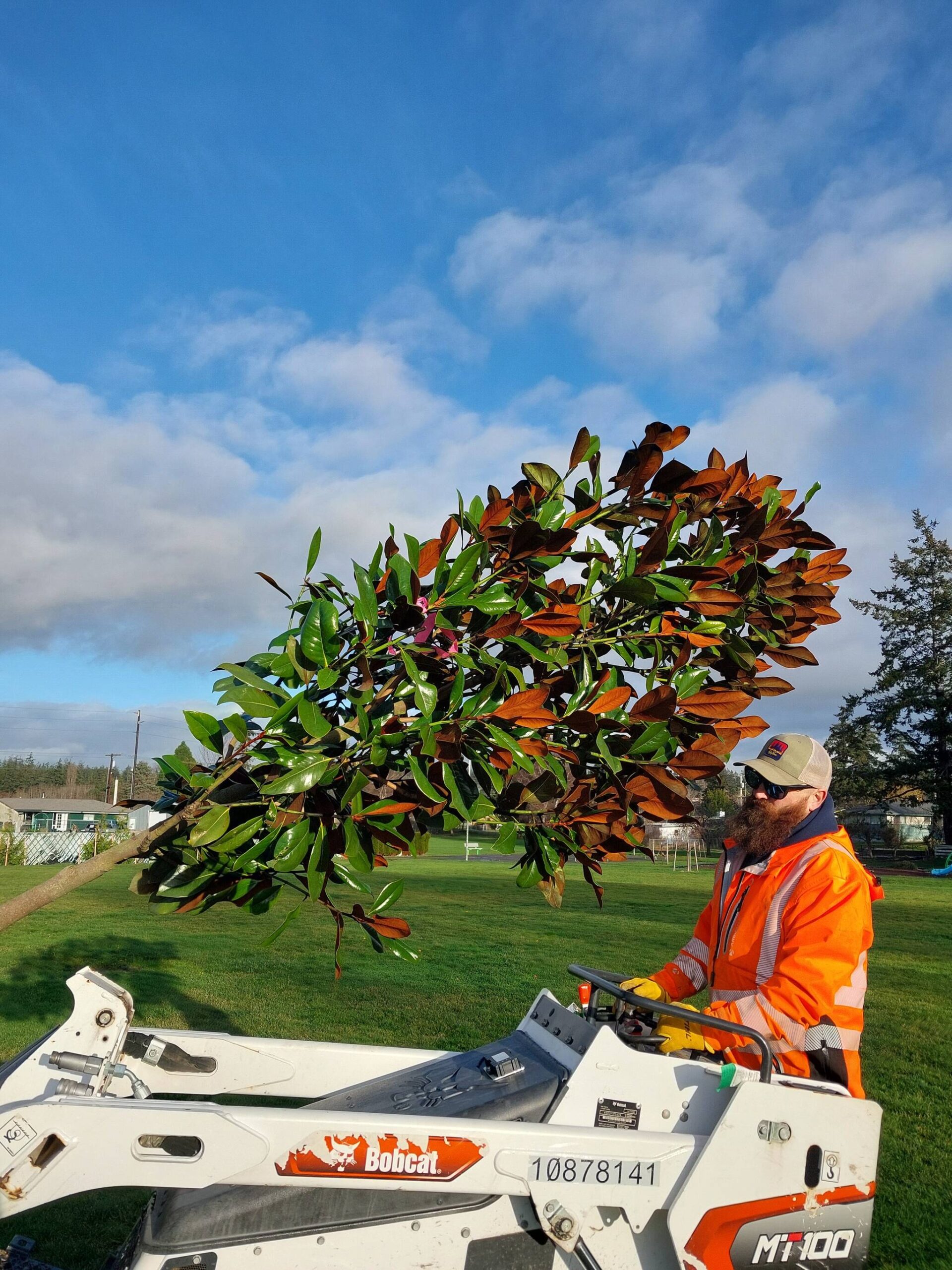
At the same time, the city of Oak Harbor’s arborist Robert Bailey said in an email that the city expanded its tree-planting and maintenance capacity by also hiring an arborist apprentice and an arborist intern through a federal grant and has planted 150 new trees throughout the city since the spring of 2024.
“In addition, the city is actively developing an Urban Forestry Management Plan to guide future efforts,” he wrote. “This plan will include revised planting standards citywide and an updated street tree planting list, with a focus on diversifying species for resilience against disease, pests and climate impacts.”
The size of a city doesn’t necessarily correlate higher or lower tree equity scores, according to the website. Seattle, for example, has a score of 87, Everett’s score is 79, while Anacortes has a score of 61 and Mount Vernon’s score is 71.
The searchable map on the website features information about communities across the nation and highlights Washington state, including urban and semi-urban areas of Whidbey Island. The score is based on tree canopy goals set for each biome as compared to the existing canopy derived from pre-aggregated Google high-resolution tree canopy sourced from Google Environmental Insights Explorer. Heat extremity and disparity were also calculated using Landsat data from the USGS Worldwide Reference System.
In addition, the score takes into account socioeconomic indicators in each community to create a Priority Index, with the idea that low-income people should have equal access to neighborhoods with trees.
Renninger pointed out that the southeast area of Oak Harbor, where the majority of mature Garry oak trees are located, has a good tree canopy score. Smith Park, which has a total of 150 Garry oak trees in a half-acre area, looks similar to how the area looked 100 years ago, according to the Garry Oak Society. The park is one of only four parks on the Washington Heritage Register.
Oak Harbor has a unique “Oak Tree Protection” section of code that seeks to prohibit the damaging, topping, mutilating or killing of Garry oak trees, with some exceptions. The city has received a Tree City USA designation each year for more than 20 years. The designation requires a community to have a tree board or department, a tree care ordinance, annual expenditure of $2 per capita on tree care activities and have an annual Arbor Day observance.
Yet Renninger was dismayed by the loss of trees associated with private development in the city. In the last three years, areas on Freund Hill, multiple areas off Regatta Drive, land at Crosby and Heller Road, property at Crosby and Oak Harbor roads and along Highway 20 south of the city have been completely stripped of trees, she said.
“The Oak Harbor Garry Oak Society encourages private land owners in the greater Oak Harbor area and the City of Oak Harbor Parks to take action now to plant more trees, particularly native species,” Renninger wrote. “If there is adequate space and sunlight, a Garry oak tree is a great choice for planting. Once established, Garry oak trees are drought tolerant.”
She said residents can support the all-volunteer effort to protect Garry oak trees by visiting the website, ohgarryoaksociety.org. The group has a waitlist for those who want to purchase a Garry oak seeding, or people can harvest acorns from the public right-of-way under oaks and plant them directly in the soil.
Bailey, the city’s arborist, wrote that the city recognizes the existing disparity in tree equity across the different sections on the community.
“Addressing tree equity is a complex issue influenced by factors such as zoning (industrial, commercial, and private), availability of public property, staffing resources and funding capacity,” he wrote. “As shown on the tree equity map, the lowest scoring areas are primarily characterized by industrial, commercial and privately owned land. For example, Census Block Group 53029906013 has a tree equity score of 48. This area contains limited public space or right-of-way not already planted, making significant improvements challenging.”
Bailey pointed out that the city’s tree equity score is better than nearby cities of Mount Vernon, Burlington and Anacortes, demonstrating that “Oak Harbor is keeping pace with, and in some cases exceeding, regional peers.”
“The city remains committed to increasing canopy coverage in underserved areas and will continue to strategically invest in urban forestry to improve long-term equity and resilience,” he wrote.
Communities on Whidbey Island historically have taken trees seriously, with tree-cutting causing controversies over the years. Most recently, the city of Langley’s decision to chop six massive Douglas fir trees as part of a stormwater infrastructure project on Edgecliff Drive stirred discontent in the city, with some residents, an environmental group and an elected leader questioning the decision and arguing that the loss of the trees will hasten erosion on a bluff.
Under Langley code, significant trees and trees in critical areas cannot be removed without a permit whether they are on public or private property.
Last year, the town of Coupeville amended a tree code to regulate canopy coverage instead of the number of individual trees necessary for new housing development. The change was a reaction to complaints that the prior code that required a number of trees that people felt was unworkable and led to overcrowding.
Oak Harbor has a long and storied history with its oak trees. Decades ago, the late Dorothy Neil, a Whidbey News-Times reporter, editor and columnist, saved the famous Garry oak tree in the middle of Southeast Eighth Street from city axing by threatening to protect it while armed with a shotgun. The tree still stands today.
In 2014, the city cut down an iconic, 330-year-old Garry oak tree at the post office without alerting the public or seeking any input ahead of time. The decision spawned a major controversy and led to the city preserving much of the wood for future projects.
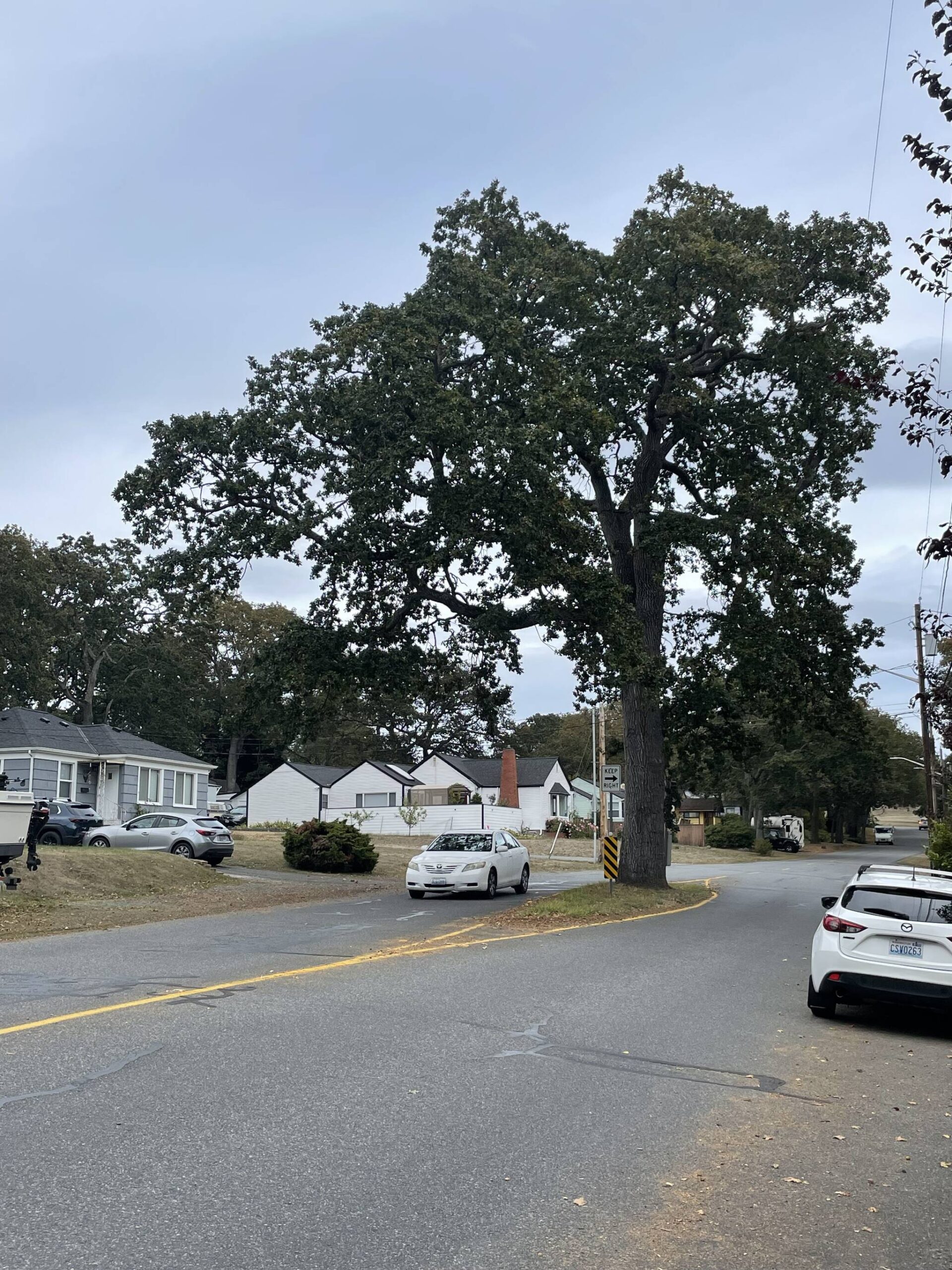
(Photo by Jessie Stensland) An iconic oak grows in the middle of an Oak Harbor street known as the Avenue of Oaks.
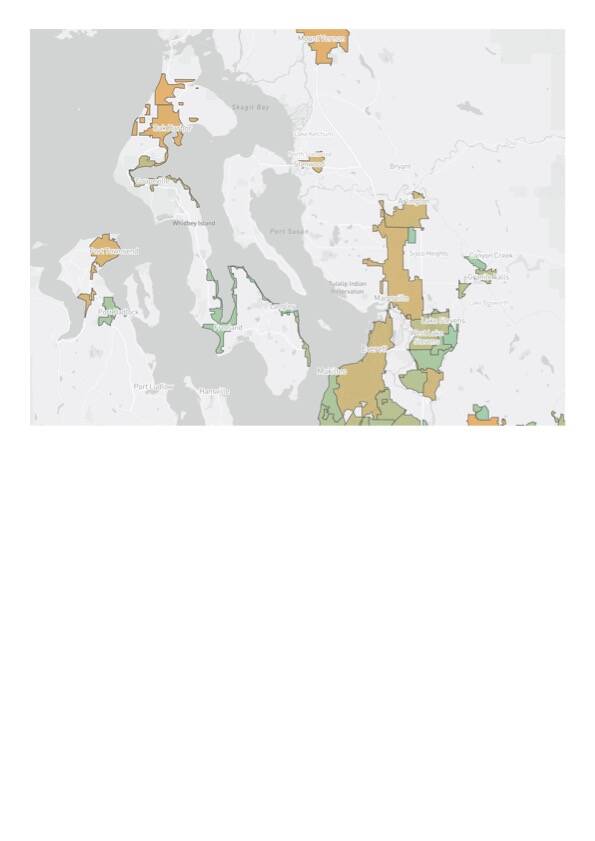
The tree equity map shows the scores on the urban and semi-urban areas of Whidbey Island. The darker green connotes the higher scores.