
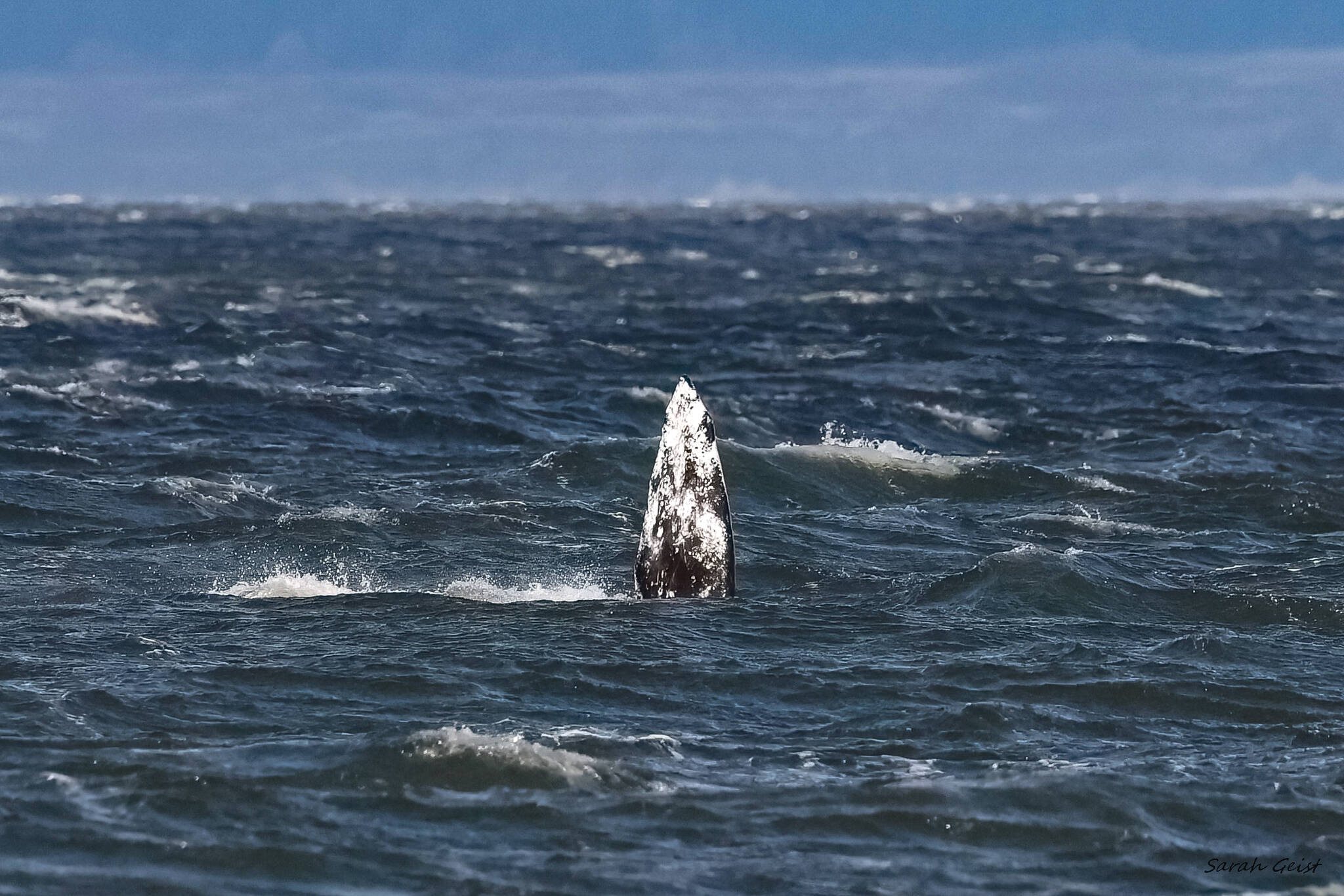
The first of the “Sounders” gray whales arrived in the Salish Sea just as torrential rains from an atmospheric river hit the area, resulting in widespread and devastating flooding on the mainland.
Little Patch, a famous gray whale with a distinctive marking, was first spotted in the Saratoga Passage on Dec. 11, which is unusually early for a Sounder. Gretchen was the second of the seasonal gray whales to arrive, as confirmed by Orca Network staff on Dec. 22, according to a press release from the nonprofit.
Howard Garrett, president of the Whidbey-based Orca Network, said flooding can be “a double-edged sword” for gray whales, which feed on ghost shrimp living in the sand. While floodwater brings beneficial organic sediment that enhances the intertidal habitat, it can also carry pollution and debris to the shoreline. A photo from the Orca Network shows Gretchen surfacing amid debris in the wake of the flooding event.
Garrett said most of the sediment that settled in the mud flats is beneficial to the ghost shrimp, worms and other creatures that live there. But the floodwaters cover roads, farmland, parking lots and other areas inevitably sweep along oil, chemicals, micro-plastics and other pollution, he said.
“I don’t think there’s been a good analysis of what’s in there,” he said.
Cindy Hansen, education coordinator for Orca Network, echoed his concerns.
“Things that wind up on the beaches after floods can also wind up in gray whales’ stomachs,” she said in a press release, “and that’s a concern for Little Patch, Gretchen and any other Sounders who might show up in the next couple of weeks.”
Garrett explained that 12 to 15 whales make up the group of Sounders. The giant baleen whales are known for their epic journey along the North Pacific Coast to Arctic waters, an annual migration that is among the longest of any creature. For an unknown reason, Garrett said, a couple of the whales — one of which is now dead — first took a detour in 1990 into the Salish Sea, where they found rich feeding grounds and delighted human residents.
Other grays followed in the years to come.
Garrett said the whales stay in the Salish Sea for up to three months before heading back out the Saratoga Passage and “turning right” toward Alaska.
Garrett said mid-February is the usual time they showed up in years past.
A press release from the Orca Network explains that the change in arrival time in recent years coincided with an “unusual mortality event,” or UME, in the overall gray whale population.
“While the UME was declared closed in 2023, the gray whale population continues to struggle with very few new calves born last winter, and many whales stranding or dying from malnutrition and ship strikes along the gray whale migration route,” the press release states. “Many migrating grays in recent years were seen in poor body condition, an indication that their summer arctic food supply is dwindling.”
Orca Network explained that the ghost shrimp living in “the sandy shores of Saratoga Passage, Port Susan and the Snohomish River estuary are an important food source for the gray whales that know about it, and throughout the UME newcomer gray whales have discovered that this part of the Salish Sea can help them survive.”
“That’s one reason for concern about contaminated floodwaters,” Hansen said. “Floods carry all kinds of pollutants downstream, some of which may be harmful to the ghost shrimp, and some of which may be directly harmful to the whales.”
The Orca Network emphasized that flooding cleanup can include shorelines.
“It’s always helpful to take along a trash bag and gloves when you visit the beach, to pick up litter that might harm wildlife,” said Susan Berta, Orca Network’s director, “but after flooding like we’ve been having it’s important to report hazardous items to the right place rather than try to remove them yourself.”