
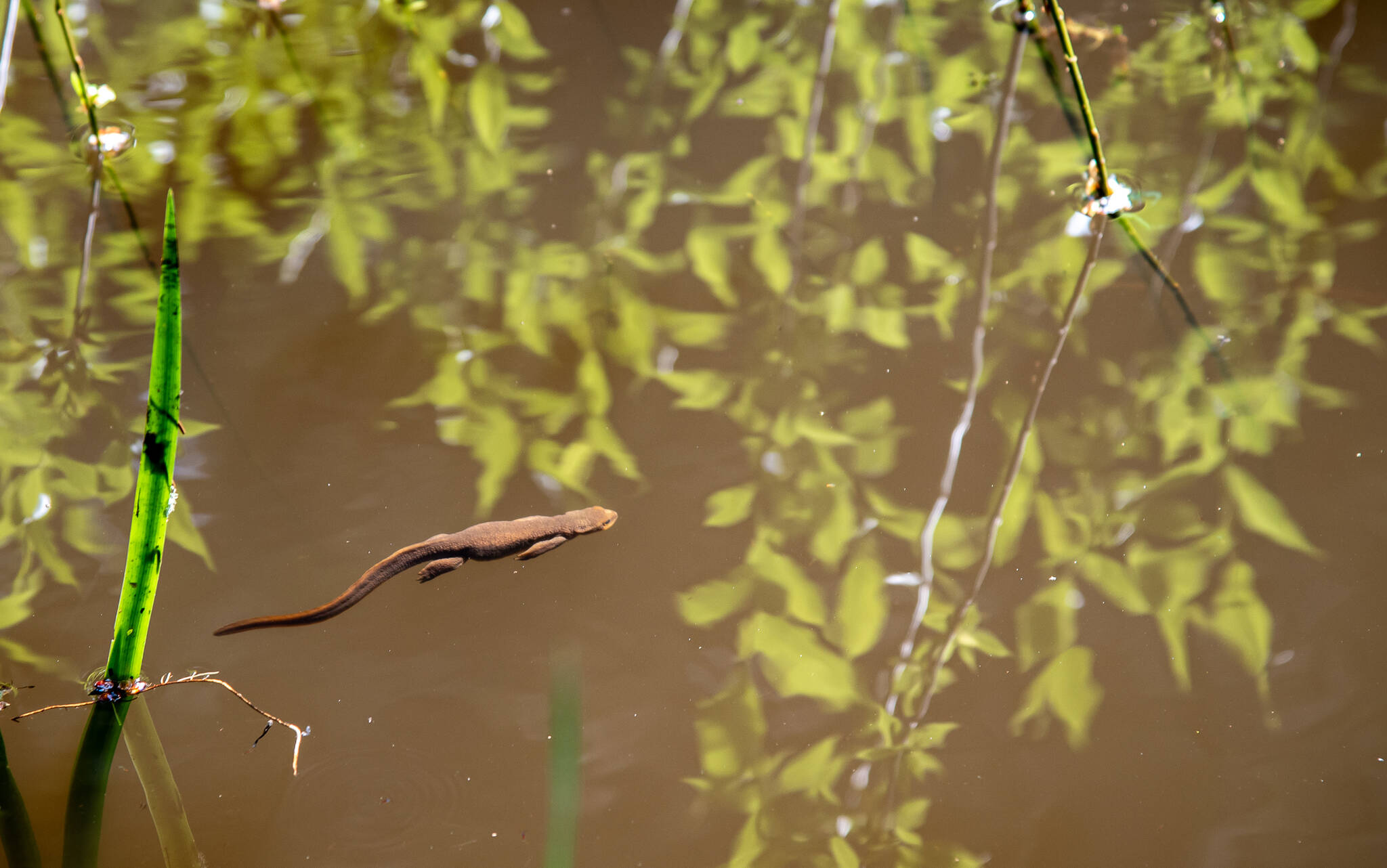
Creatures from the Earth’s ancient past are on the move, and Island County officials want to make sure Whidbey residents don’t run them over.
In fact, it’s the tail end of the annual migration of juvenile newts from the ponds where they were born to the woodland areas they will spend most of their lives roaming. They may hibernate during colder weeks or months in cozy spots under logs or rocks or leaf litter. Then in the spring, the surprisingly large amphibians will march back to ponds to breed.
These trips are risky, as newts are slow moving and unafraid of traveling during the day since they are protected by their slightly poisonous skin, according to a notice that Island County Public Health recently sent out.
Whidbey Island is home to several types of amphibians, which play vital roles in the ecosystem. The most common type of newts, which are a kind of salamander, are called rough-skinned newts; they are commonly brown to black with bright orange-ish undersides.
They are easy to spot during these mass movements and “dangerously exposed to traffic as they slowly march across the paths,” the precaution states.
Ron Newberry, the garden operations manager at Meerkerk Gardens in Greenbank and a lifelong amphibian fan, said the juvenile newts that are born in the ponds of the 40-acre rhododendron gardens and woodlands headed out earlier in the fall, so spotting them now is unlikely.
Yet the newts’ return in the spring and summer is an amazing sight, as the 7-to-9-inch creatures fill the ponds to meet, greet and breed. Newberry said he counted 50 newts in one pond at the height of breeding season.
The newt-filled ponds are an attraction that draws visitors to the nonprofit gardens in June and July.
“They are special. They are really fun to watch,” he said. “People call them little dragons.”
Actually, newts and their kin descended from salamanders that existed millions of years before dinosaurs. Newts have legs positioned to the side in a sprawling gait, a primitive type of locomotion that dominated before most terrestrial animals evolved into an erect posture with legs positioned below the body.
Rough-skinned newts are the state’s most poisonous newt and have toxins that can cause mild skin irritation if touched but much more serious symptoms if ingested, according to the Burke Museum. Their glands produce the same neurotoxin that is found in Japanese puffer fish and blue-ringed octopus. Years ago, a man in Oregon died after eating one on a dare.
Shawn Morris, director of Island County Public Health, explained that residents have reported sightings of newts on Whidbey through the nature observation app iNaturalist. He encourages residents who spot newts to report it through the app.
Morris explained that newts “are most commonly found in forested areas and are most active when temperatures are moderate and the ground is wet.” They may travel long distances to breed in aquatic habitats, which include ponds, wetland, lakes, road ditches and slow-moving creeks.
“The rough-skinned newt is one of only three Washington amphibians (along with tiger salamander and long-toed salamander) that lays single eggs, and it is the only one that hides its eggs within vegetation,” he wrote, citing information from the state Department of Fish and Wildlife.
There are no known declines in newts on Whidbey or in the Pacific Northwest in general. Kurt Licence, a district wildlife biologist for Fish and Wildlife, said he’s encountered plenty of rough-skinned newts across the island. He’s not aware of pathogens like Bd or Bsalof being detected on Whidbey. Batrachochytrium salamandrivorans is a newly emergent fungus that has devastated salamander and newt populations in Europe.
Licence explained that the neurotoxins in newt skin are also present in their eggs, but that some species like garter snakes and potentially barred owls are resistant to the chemical.
Island County Public Health pointed out that amphibians are essential to the ecosystem health, particularly as pest controllers and playing their part in the food web.
“Since the survival of the newt population depends heavily on the juveniles and adults successfully crossing paths during migration, people who share the landscape can help minimize fatalities by being vigilant,” the notice states. “If a live newt is spotted, it can be safely moved to the grass on the opposite side, maintaining its original direction of travel (with handwashing afterward). Simply avoiding stepping on them or running them over is vital, as these small actions can limit human impact and increase the long-term survival chances of this newt population in an urbanizing environment.”