
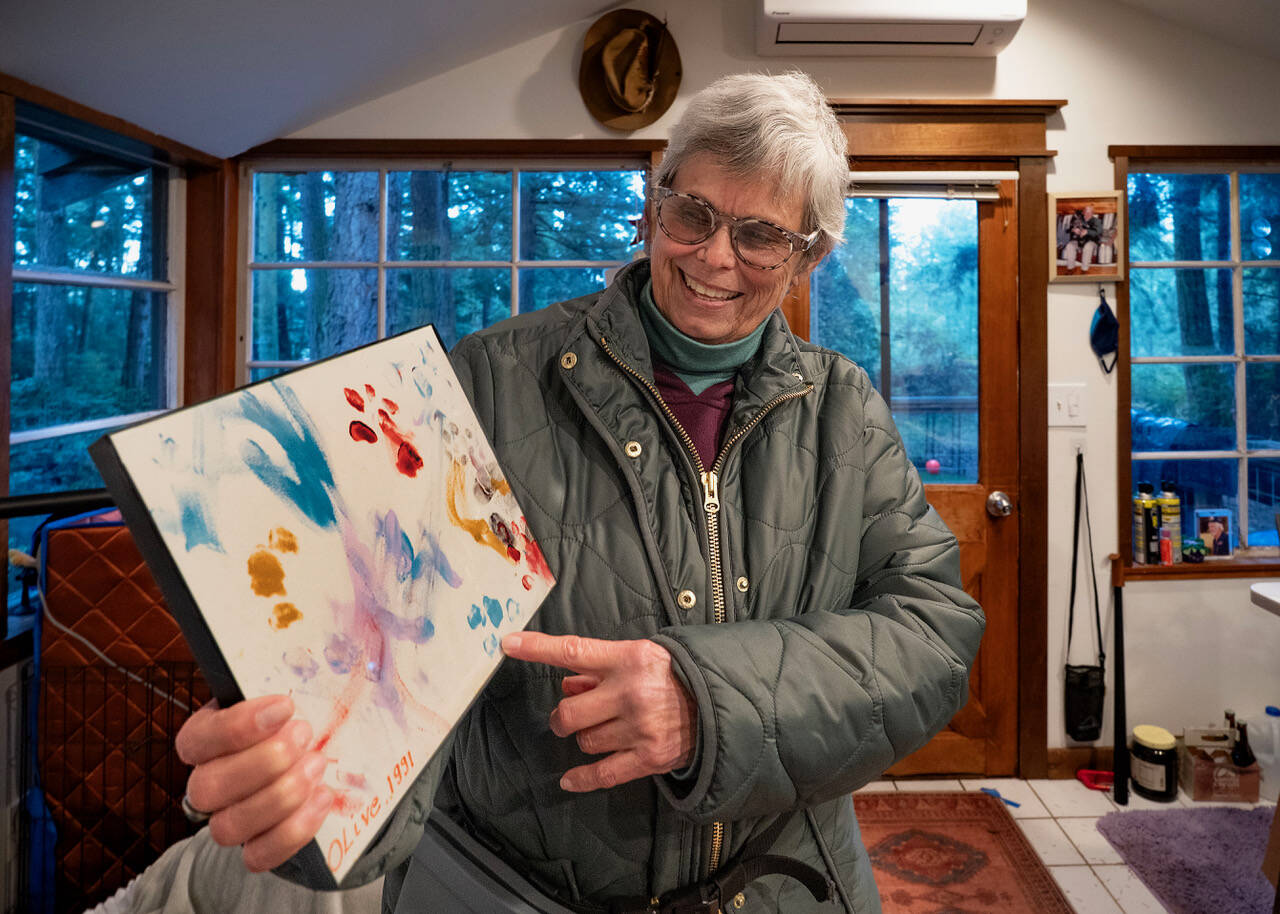
Though she now spends her days among the island’s pooches, there was a time when South Whidbey dog trainer Jan Naud interacted with a more dangerous clientele.
Naud spent the earlier decades of her life raising and training wild animals – some of her own, some for wild animal parks and others for traveling circus shows. She has stood underneath big cats, led elephants around by the trunk and delivered food to a herd of wild buffalo that could have easily trampled her.
“I raised zillions of baby lions and tigers and bears and wolves,” Naud said. “I was actually quite a famous baby raiser because when I raised cubs, they always lived.”
Apart from a bite to the back from a leopard and a bite to the arm from a baboon, Naud has relatively few scars to show for it. She credits reward-based training for her success with animals. Back in the day, positive reinforcement was seen as a departure from the old-school methods of punishment-based training.
“There are ways to train animals – even big cats or elephants – without being abusive,” Naud said.
Later in life, she transferred these positive techniques of training over to dogs, offering treats to motivate them and build trust. Her no-frills approach involves the owner, helping them to create a stronger bond with their animal companion – hence the name of her business, Training as a Team.
“Being on this island, everyone loves dogs like no place I’ve ever lived,” Naud said.
She spent the past 25 years in the L.A. area, where it was common to have celebrities get their dogs trained as a matter of status, rather than a passion.
Naud moved to Whidbey earlier this year with the encouragement of her older sister Dawn Pinaud, who owns Coffee at Dawn near the Whidbey Airpark in Langley. As always, the local wildlife provided a big draw for her, especially when she saw a photo of a deer and three owls in a tree in her sister’s yard.
“This is the most magical, fabulous place,” Naud said. “I drove from L.A., I got out of my car right here and I just started crying.”
Naud has been training animals from a young age. When she was growing up, boys had paper routes or mowed lawns and girls did the babysitting. But at the age of 7 or 8, Naud knocked on every door in the neighborhood and asked people if they had a dog she could train.
Her father, the first master falconer in the state of California, had plenty of birds of prey in their backyard, ranging from little kestrels to large eagles. Naud had her own raven and owl from a baby.
Naud wanted to be a veterinarian, but at the time, women faced significant barriers to studying the profession in college. So she got a job during the summers working for the wild animal park where her father was employed, starting with the petting zoo.
Ironically, she befriended Dr. Murray Fowler, one of the pioneers of exotic animal medicine. She asked to sit in on one of his all-male veterinarian classes at U.C. Davis. When the discussion turned to raising cubs, Fowler would invite Naud up to tell the students how to do it.
“These people are taking notes off of me, and I can’t even get into vet school,” Naud said.
But had she pursued a career in veterinary medicine, she wouldn’t have been able to do all the things she did as a wild animal trainer, including raising four baby baboons to adulthood – three females and a male. One of them, Olive, became the anti-graffiti, drug-free baboon for the city of Albuquerque in the ‘90s, where Naud worked with at-risk youth. Bumper stickers, city buses and billboards read, “Olive says … wipe out graffiti.”
Naud recalled one little boy who was with her and wanted to cover Olive’s eyes when they passed by some graffiti in town.
“It was the cutest thing,” Naud said. “Those kids really thought that Olive hated graffiti. It was hysterical.”
Naud also had two orphaned bats and spent time educating people about them. During the day, you could hook them to a bra strap and they would hold on with their little claws. At night, they wanted to wake up and fly around in their cage.
An inner-city school in upstate New York asked Naud to bring her bats. Her friend she was staying with scoffed and told her city kids didn’t want to learn about bats.
“I couldn’t get out of that school to save my life,” Naud said. “They were so into it, it was amazing.”
Educating kids about animals has been extremely rewarding because they’ll do anything to learn about them, Naud said, even if they’re the troublemaker in class or they don’t like other people.
The power of animals has a way of changing things for people, young and old. Olive was a favorite guest at a certain retirement home, and art painted by the baboon decorated all the hallways.
Naud traveled all over the country to work in parks or in shows.
“Most of the time I didn’t make money at all. They gave you housing and food,” she said. “But I was into working with wild animals, and where else can you go? My mother used to always complain, ‘How can you do this?’ Well, I did it. And I would never trade it for a million years ‘cause it’s fun, and what kind of people get to do this kind of thing?”
For all the risks she took, Naud experienced just as many tender moments from her time as a wild animal trainer. There’s the escaped baby burrowing owl at a youth summer camp that she worried would be eaten alive if not found – but was saved when it got stuck in a spiderweb; the emaciated mother mountain lion who brought her cubs to Naud every day to take care of; the chimp she raised from a young age that recognized her years later in the audience of a show.
There were also celebrity encounters galore. Naud trained a big cat that was featured in “The Incredible Hulk” TV series of the late 1970s starring Lou Ferrigno. She also trained a leopard to walk by Cher during an episode of her weekly variety show.
“She was like completely freaking out,” Naud remembered of Cher.
Over the years Naud learned much about the personalities of wild animals, including the different big cats.
“When you train a tiger, they’re very dog-like,” Naud explained. “They’re very compliant. They like to work. A lion will eat you in five seconds because they don’t want to do anything except sleep.”
That’s not to say a tiger won’t eat you, however.
Now most of Naud’s time is spent in the company of canines, a far less hazardous job but just as interesting. No more baboons or bats live in her home, but she does have a miniature poodle named Domino and a Tibetan terrier standard poodle mix named Jet.
In her nearly one year on Whidbey, Naud has enjoyed getting to meet other people who love their four-legged companions. She even plans to host a monthly “dog talk” at one of the libraries; her first at the Freeland Library earlier this month attracted 19 attendees.
To get in touch with Naud, visit her website, trainingasateam.com, or email jannaud1919@gmail.com. She also welcomes remote training opportunities and can answer brief questions via a free phone consultation at 818-261-6963.
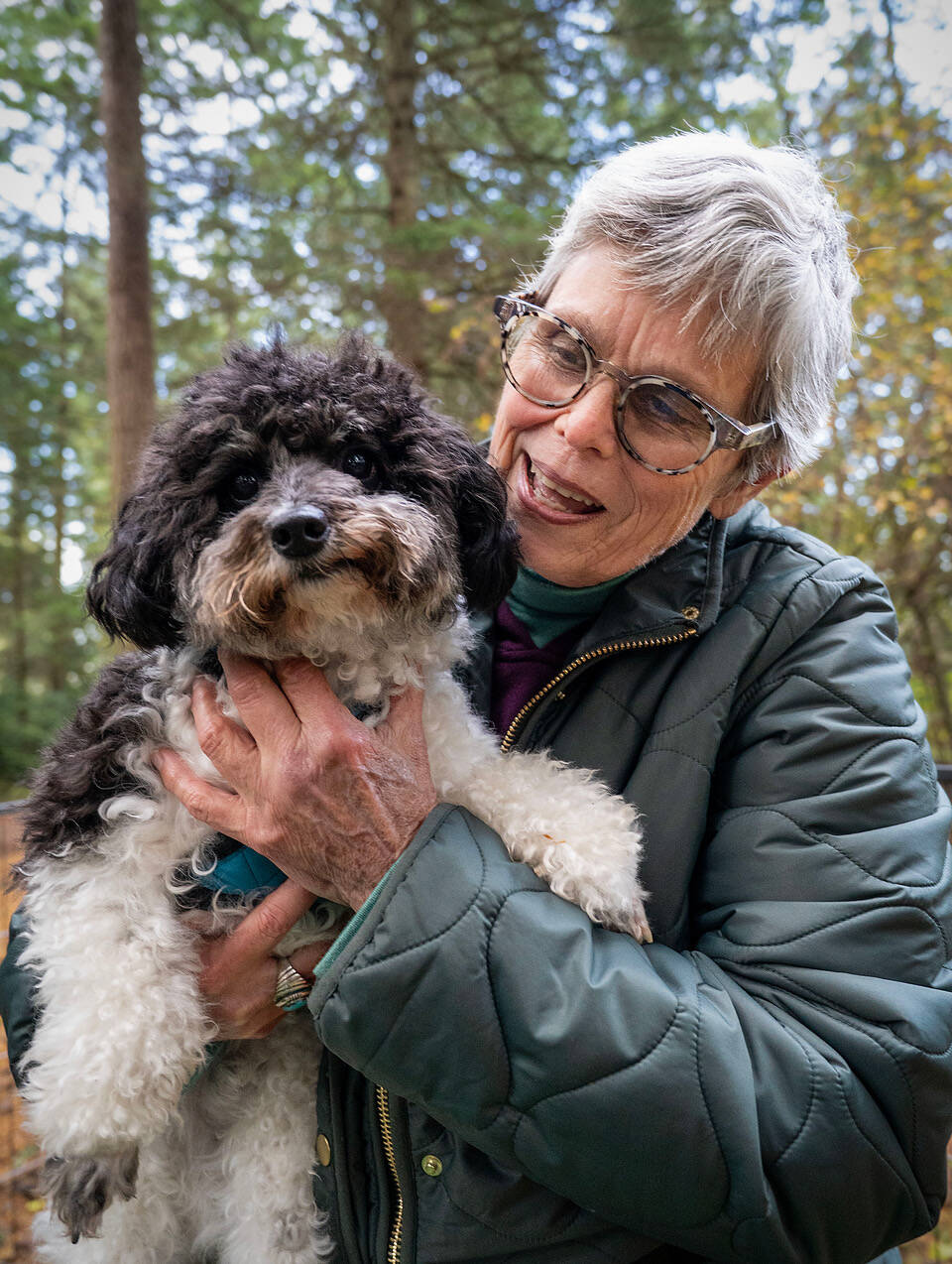
(Photo by David Welton) Jan Naud cuddles with Domino, her miniature poodle.
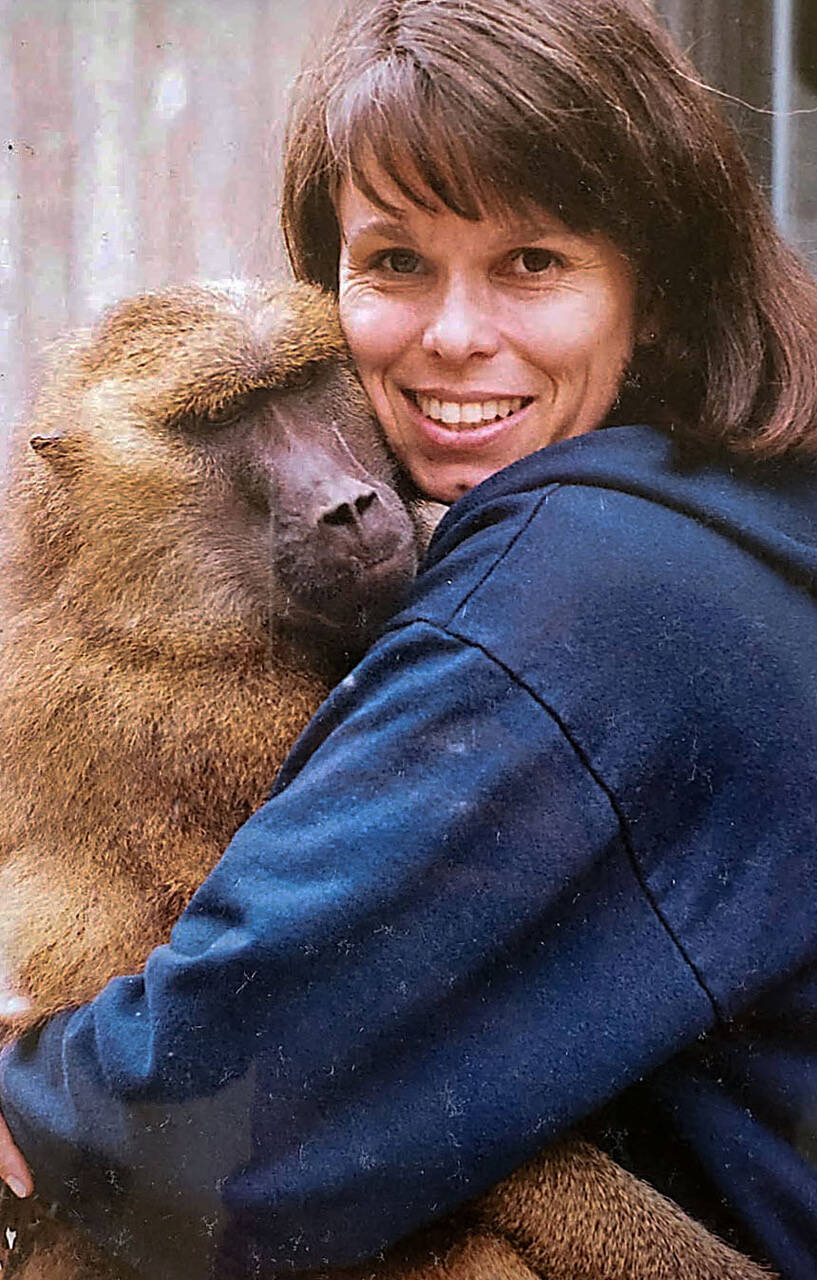
(Photo provided) A young Jan Naud with Olive, the anti-graffiti, drug-free baboon for the city of Albuquerque in the ‘90s.

