Freeland woman appears on Times Square billboard
Published 1:30 am Tuesday, September 9, 2025




By LUISA LOI
Special to The Record
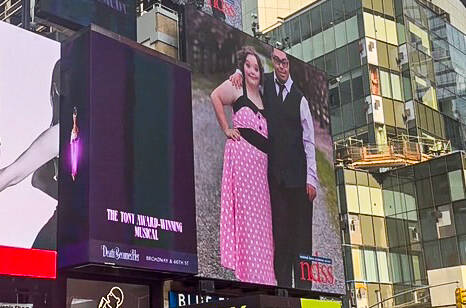
Hundreds of New Yorkers and visitors passing through Times Square between 9:30 and 10:30 a.m. last Saturday likely spotted two digital billboards displaying a chic Freeland woman and her boyfriend.
When Zoe Thompson’s giant prom photo finally appeared among the flashy advertisements surrounding the square, the 21-year-old turned to her mother with a smirk, seemingly pleased but unsurprised. A few moments later, when the realization of what had just happened finally hit her, “sassy pants” abandoned her composure to join Tiffany Wheeler-Thompson’s freak-out.
After 15 years of unsuccessful photo submissions, Thompson was finally chosen to be among 500 people from the United States and beyond to be featured on the National Down Syndrome Society’s video presentation that kicks off the Buddy Walk, a yearly series of walks that take place around the country to celebrate and raise awareness about Down syndrome and the diversity within its community.
Her mother, Wheeler-Thompson, had goosebumps as she filmed the once-in-a-lifetime event.
When her daughter was born, she didn’t know whether she was going to live past her first birthday because of a congenital heart defect, nor if she was ever going to walk — let alone work or find a partner.
After undergoing heart surgery and a double cataract surgery, Thompson continues to deal with chronic inflammation that forces her to get monthly infusions at Seattle Children’s Hospital, and she can’t walk long distances due to her tarsal tunnel syndrome. She also recently had a device surgically implanted into her chest to treat her severe sleep apnea.
According to the National Institute of Child Health and Human Development, people with Down syndrome are at increased risk for some health conditions, though people with Down syndrome are not all the same and may experience different challenges at varying degrees of severity.
While on one hand raising a child with Down syndrome is not easy, Wheeler-Thompson said, it can also be highly rewarding and joyful. One of those uplifting moments, she recalled, was seeing Thompson’s excitement at the sight of Disney princesses strolling through Central Park, where hundreds of families walked, pranced and wheeled with their “homies with extra chromies” — as they’re known in the Down syndrome community — for the Buddy Walk.
Though people with Down syndrome can experience different health and cognitive challenges, Wheeler-Thompson finds there are a lot of misconceptions when it comes to what people with disabilities can and cannot do.
In Thompson’s case, being honored in one of the most popular landmarks in the country’s most populous city is only the cherry on top of a list of accomplishments where she defied initial expectations.
When she isn’t video calling her boyfriend of six years, Darrius, or amusing family members with her sassy attitude, Thompson keeps herself busy with a plethora of commitments, like cleaning at Freeland’s Island Athletic Club, cheerleading in South Whidbey High School’s Sparkle Squad and training with South Whidbey Wind’s basketball team and Team Whidbey’s swim and bowling teams.
Last year, she qualified for the state Special Olympics bowling tournament, where she won a silver medal.
“She’s a busy girl,” Wheeler-Thompson said, adding that her daughter was mildly upset about missing bowling practice on Monday while still visiting the Big Apple.
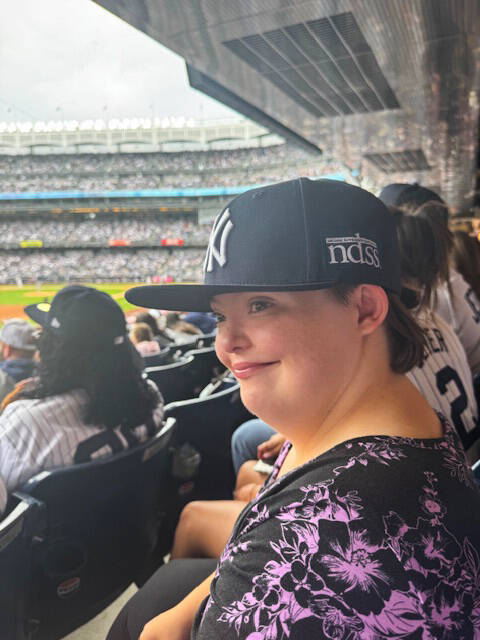
It was a weekend of firsts for Thompson, who had only been to Washington and California before and had never taken the NYC subway. Sunday, the family joined the National Down Syndrome Society at Yankee Stadium, where the family had to set aside its loyalty to the Seattle Mariners and root for the New York Yankees as they faced the Toronto Blue Jays.
Surrounded by people with Down syndrome and their loved ones, Wheeler-Thompson said she feels proud of the community for the understanding and support families share with one another, as well as for the growing acceptance and appreciation for the condition.
People’s attitudes towards Down syndrome have come a long way. Until about 50 years ago, most physicians advised parents to send their children to institutions, where they would experience inhumane conditions and remain hidden from society, according to the National Association for Down Syndrome.
Today, people with the condition are increasingly integrating into society. As Down Syndrome Awareness Month falls in October, those wishing to join the celebration and help raise awareness can attend the Puget Sound Buddy Walk at Woodland Park Zoo in Seattle, from 10 a.m. to 1 p.m. on Oct. 12.
To register, visit the “2025 Puget Sound Buddy Walk” page on the Down Syndrome Center of Puget Sound’s website.