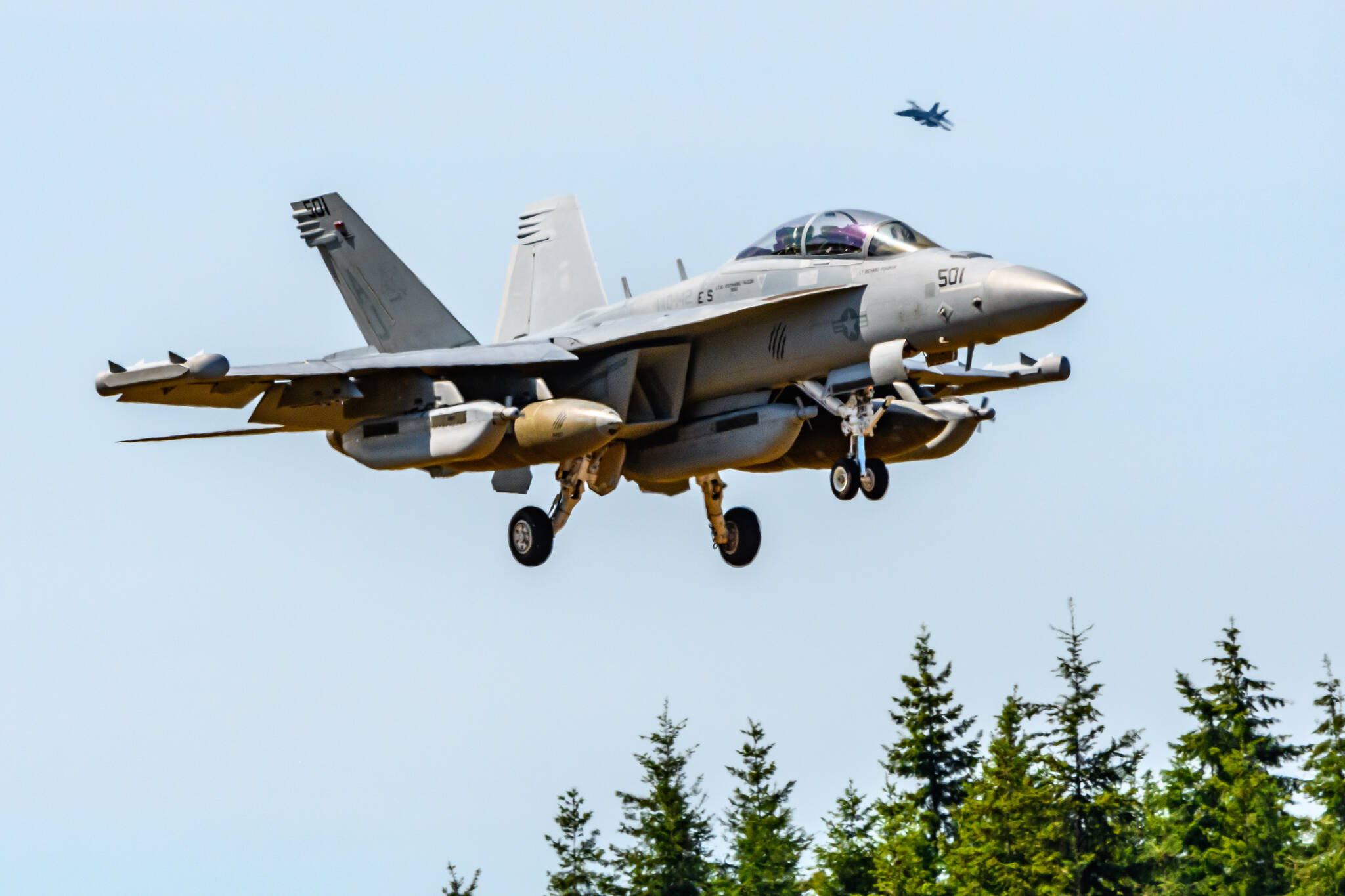
The Navy released the final amended analysis for the Environmental Impact Statement on EA-18G Growler aircraft operations at Naval Air Station Whidbey Island.
People can read the document, which was released Friday, at www.nepa.navy.mil/growler.
Representatives from the Citizens of Ebey’s Reserve, an anti-noise group known as COER, and the Oak Harbor Navy League said they couldn’t immediately comment because they didn’t had a chance to read the entire document yet. Bob Wilbur, a spokesperson for COER, said he wasn’t sure what the next step in the process is or if the case will head back to court.
Likely the most significant conclusion in the 86-page document is an acknowledgment that noise from Growlers will have impacts on childhood education at schools on Whidbey Island, but it states the effects on test scores will be partially mitigated by the base’s efforts to reduce operations during academic testing periods.
The analysis doesn’t address how $47 million in federal grants awarded to Whidbey Island schools this year for noise mitigation might further mitigate noise exposure impacts on childhood learning. The Department of Defense, which is now the Department of War, awarded Oak Harbor Public Schools a total of $38 million for three elementary schools while Coupeville received $9 million.
Two years ago, U.S. District Court Judge Richard Jones ordered the Navy to redo sections of the original Environment Impact Statement, or EIS, which was prepared prior to the increase of Growler jets at the Whidbey base. After the original EIS was finalized, Navy brass approved an increase of 36 Growlers at NAS Whidbey as well as a four-fold increase in touch-and-go training at OLF Coupeville.
In 2019, the state Attorney General’s Office and COER filed a lawsuit over the EIS, arguing that it violated the National Environmental Policy Act by failing to fully analyze available information. The judge agreed on four points, ordering the Navy to update emissions calculations and explains the basis for those calculations; expand the analysis of species-specific impacts on birds; refine the analysis of the impact of increased operations on childhood learning based on the best available science; and reassess whether relocating some or all of the Growler community to Naval Air Facility El Centro is a reasonable alternative.
Release of the final amended evaluation was delayed by the closure of the federal government in the fall.
In the conclusion, the amended evaluation finds the increase in greenhouse gases from Growlers would be nominal and “not result in any meaningful adverse GHG impact on a global scale.”
The analysis states that the aircraft training would not likely result in significant adverse impacts to state-listed species or their habitats. It states that stressors would be “intermittent and brief” and “would not disturb breeding, feeding and nesting behavior of individuals to a degree that would cause significant effects on their populations.”
Relocating Growler operations to El Centro, the document concludes, would result in degraded effectiveness as well as being prohibitively expensive. The document states that such a move would increase the number of people affected by Growlers and would impose unnecessary burdens on sailors and their families.
The conclusions on childhood learning, however, are less clear cut, the document indicates. It concludes that Crescent Harbor Elementary School would experience the greatest noise exposure, which may result in a one-month delay in reading comprehension. In addition, students at some schools — including Crescent Harbor Elementary and Coupeville Elementary School — could experience negative impacts to long-term memory, reading comprehension, math test scores and failure rates.