The last Langley City Council meeting of the year was an eventful one.
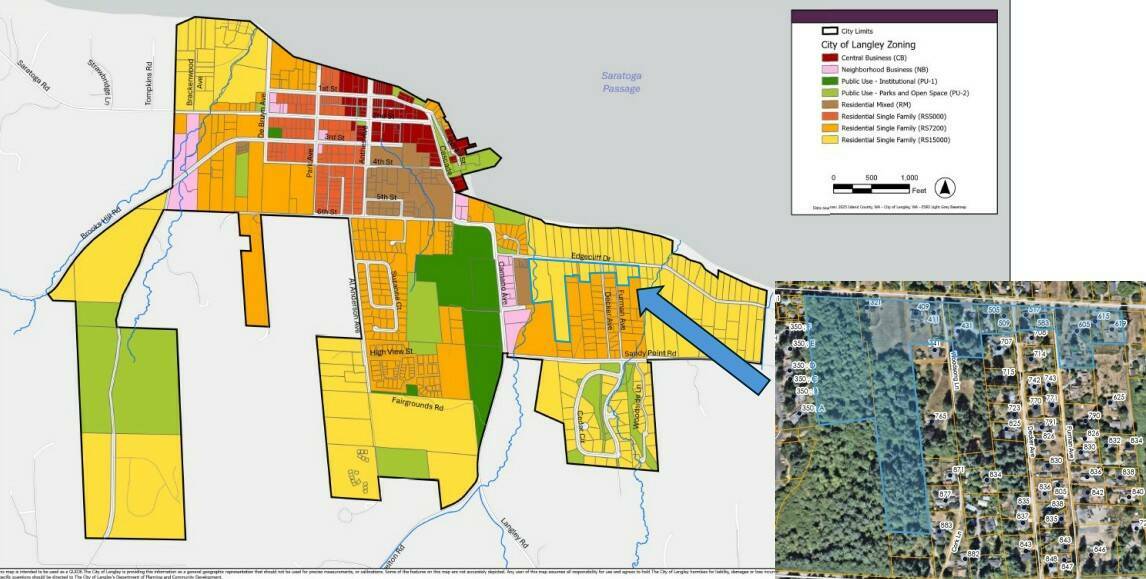
After much deliberation, the zoning won’t change for a group of properties located on the south side of Edgecliff Drive. The council voted 3-2 Monday night to retain the current RS7200 zoning.
The vote was a reversal of a previous decision made at the council’s Dec. 1 meeting that was accompanied by some tension. During that meeting, Councilmembers Harolynne Bobis, Gail Fleming and Rhonda Salerno all voted in favor of “downzoning” the area to RS15000, while Councilmembers Chris Carlson and Craig Cyr voted against it. Bobis initially wanted to withdraw her vote but then changed her mind.
At the meeting this week, where the issue was revisited for a second reading of the ordinance, Bobis voted with Carlson and Cyr instead of the other two council members.
Carlson maintained that keeping the current zoning can create opportunities for affordable housing. He highlighted city staff’s findings of no difference in potential clearing of trees between RS7200 and RS15000. He reasoned that new stormwater drains on Edgecliff Drive, installed thanks to the ongoing Langley Infrastructure Project, will help mitigate surface level runoff.
“We rarely have guarantees, but we can influence the likelihood of moving the city in the direction of affordability, inclusivity and sustainability, or the status quo of exclusivity, high home values and aging, unsustainable population,” he said.
Salerno stood firm in her position that changing the zoning would be the best thing to protect the nearby bluff from future landslide activity because of less density allowed. It would also be consistent with the parcels on the north side of the street, which are zoned RS15000.
The current zoning allows single-family residential use with a 7,200-square-foot-minimum lot size and free use of the city’s multi-family infill code. The proposed change would limit development to single-family homes with a 15,000-square-foot lot size, which does not allow for multi-family infill development.
Fleming, who lives on one of the affected properties, brings an insider’s perspective, having discussed with her neighbors about whether they plan to utilize the city’s multi-family infill code for development and finding that it only applies to one parcel. Though a Langley resident has questioned whether Fleming’s participation in the vote represents a conflict of interest, Mayor Kennedy Horstman said that both state code and the city’s attorney supports the council member because it qualifies as an “area wide rezone,” not a “site specific rezone” or quasi-judicial rezone.
Cyr said he had heard from a developer who was potentially interested in building multi-family housing in the area. Immediately, Salerno interrupted, saying it was inappropriate for him to be talking to developers as a council member.
Cyr responded, “Totally appropriate for me to talk with anybody that’s interested in the policies that were in the zoning that we’re talking about here.”
Meredith Penny, the city’s planning director, and the citizen-led Planning Advisory Board have both recommended retaining the current zoning of RS7200. A letter from Natural Resource Specialist Kelly Zupich with the Island County Shore Friendly Program said the RS7200 zoning “appears to result in fewer impervious surfaces and allows for the preservation of more vegetation,” though Salerno was critical of this information and said that only applies in the case of a housing project that uses the city’s multifamily infill code.
It turned out to be the last vote for Bobis, Fleming and Salerno, whose terms on the city council end on Dec. 31.
Their closing statements appeared to mirror how they felt about the issue. Bobis, who is planning a move to Seattle, said she didn’t agree with the city’s priorities.
“I think to this council, trees are more important than people, and I don’t see how you handle your aging population, keeping your businesses afloat, with trees and no people,” she said.
Salerno highlighted some wins in affordable housing, including a new requirement for inclusionary zoning that applies to projects using the city’s multifamily infill code. She grew increasingly teary as she recounted her passion for protecting the environment.
“The people that I know are grateful for me speaking up for the environment, and I know that might not be the people you all hear, but that’s what I hear and that’s where I get some gratitude,” she said. “I’m sorry that that’s not more of a priority for us and it doesn’t look like it might be in the future, but we’ll see.”
Fleming remained characteristically brief in her remarks, saying she contributed where she could according to her own priorities. She acknowledged incoming council members Thomas Gill, Dominique Emerson and Savannah Erickson for their institutional knowledge.
“I have full confidence,” she said.
The mayor commended all three outgoing council members for stepping up and serving as elected leaders during a challenging time with a lot of change going on.