Langley residents are continuing to question if the installation of stormwater infrastructure in the eastern part of the city is the right course of action when considering trees near the bluff that may be in the pathway of construction.
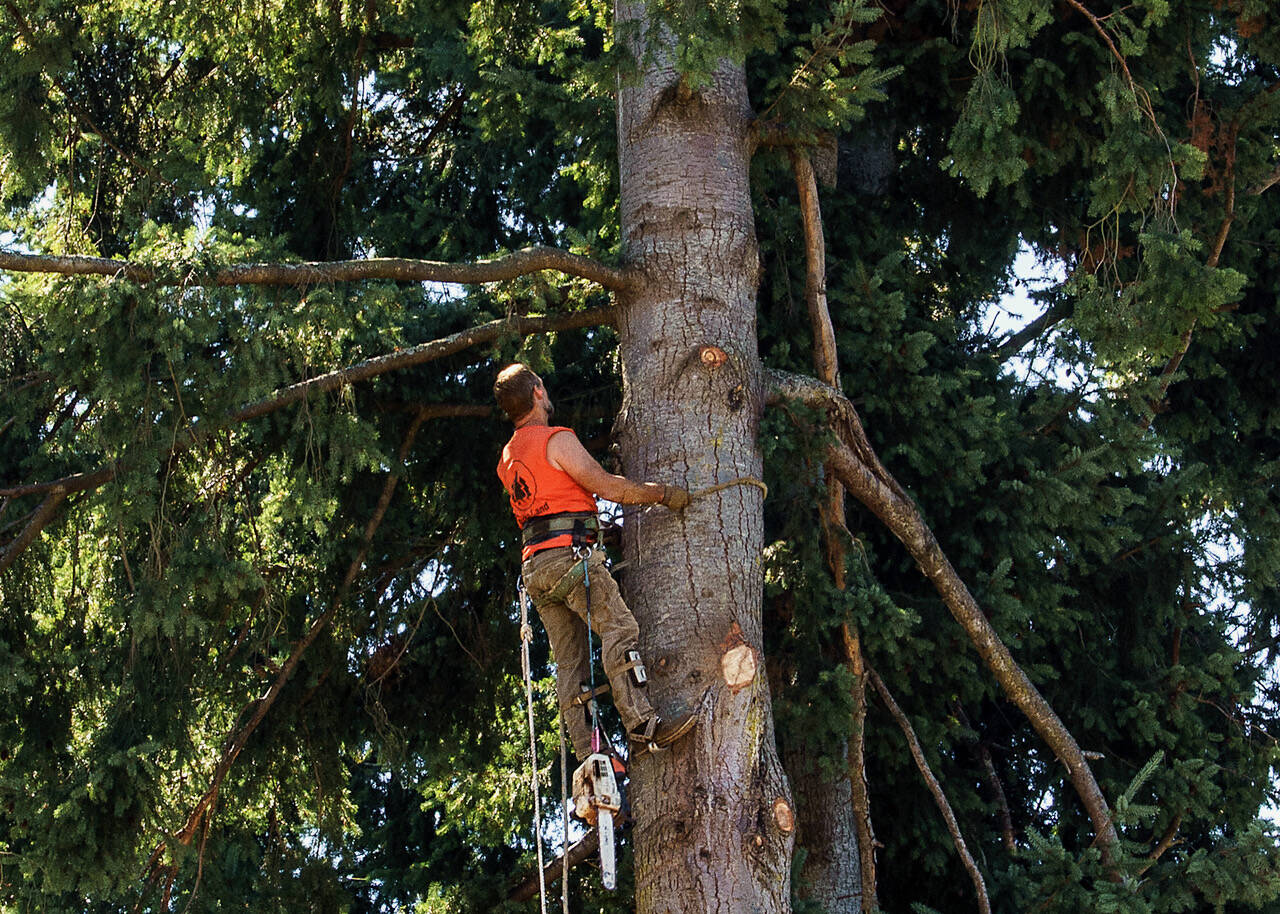
For over a month now, concerned citizens and city staff have been grappling with how to balance the protection of trees with human safety and the progress of the Langley Infrastructure Project, or LIP, along Edgecliff Drive. In July, six massive Douglas firs were removed near the intersection of Furman Avenue with Edgecliff Drive, to the dismay of neighbors in the area. The city asserted that the trees had to come down because they posed a safety hazard to workers and people living nearby, while arbor advocates argued that they were helping to stabilize the bluff.
Tensions ran high among the city council, the mayor, the public works director and members of the public during a meeting this week.
Mayor Kennedy Horstman read two prepared statements on the controversial topic, the first of which addressed the costs, risks and redesign considerations for LIP-5, the subproject that brings stormwater infrastructure out to the section of Edgecliff Drive between Furman Avenue and the city limits. At a previous meeting, the city council asked the mayor to evaluate the possibility of cancelling or redesigning LIP-5.
As Horstman explained in her memo, the subproject’s design was fully funded by the Rural County Economic Development grant from Island County and cancelling it would require repaying $196,377 to the county. In addition, equipment already purchased for stormwater management — valued at approximately $66,217 — would become a sunk cost if LIP-5 is abandoned. This does not include $35,000 of labor that has already been expended.
Apart from the cost, there could be legal and environmental liability. Abandoning a part of the project would likely be viewed as a breach of contract, Horstman said, and the city could be held liable for bluff failure due to unmitigated water infiltration from a compromised roadway.
Besides providing stormwater infrastructure, LIP-5 will bring repaving improvements to Edgecliff Drive, which will be lost if it is cancelled.
Moving utilities to the south side of the street, as some have suggested doing, would require a redesign of the project and significantly increase costs.
“Since the water project is funded by utility ratepayers — not the bond — those added costs would result in higher water rates,” Horstman stated.
In addition, the area’s existing water main pipe is at the end of its life, and its replacement is not optional, the mayor said.
Her second statement addressed the LIP as a whole and tree protection.
“Grief at the loss of trees is real – no matter how you perceive the value of trees and no matter how the loss occurs. It’s appropriate and necessary to grieve the loss of every tree and anxiety around anticipated loss is also real,” Horstman said. “However, grief or anxiety that becomes grievance over misunderstanding and misinformation is counterproductive.”
Though the council had requested using ground-penetrating radar to assess at-risk and valuable trees in the construction zone, the mayor said it is not recommended at this point because it will not eliminate the need for soil excavation within the critical root zones of neighboring trees. Horstman also outlined the steps that should be taken when it comes to pruning trees.
Councilmember Rhonda Salerno, who appealed the removal of the six Edgecliff Drive trees, suggested the council could ask for a peer review by a “non-biased” engineer who can look at all the facts, though Councilmember Harolynne Bobis expressed some skepticism at what this action would cost.
Salerno said she didn’t want everyone to take what the mayor said as holier than thou because there are science and facts behind the issue, and neither Horstman nor Salerno are engineers or tree specialists.
Councilmember Gail Fleming, who lives on Edgecliff Drive, said there is a lot of confusion about the tree protection protocol.
“The protocol was followed. The protocol was over-followed,” the mayor interjected.
Fleming said she hadn’t seen anyone from Facet, the contract management vendor, to which Public Works Director Randi Perry responded this wasn’t the case. Perry said she is going out more frequently and taking time away from her other duties to make sure Facet is on site. She added that it’s a complex issue, and there isn’t a lot of “wiggle room” in funding.
Councilmember Chris Carlson said at this point it’s clear that it’s not financially or legally feasible to abandon LIP-5 and suggested focusing on understanding tree protection protocol instead. He did, however, identify a potential oversight – the arborist’s report recommended that a certified arborist oversee pruning of tree roots, but this was absent from the bid package signed by both parties.
While Perry said she could look into this, she felt strongly that if she was a ratepayer she wouldn’t want to shoulder the cost of a $20,000 or $30,000 bill from an arborist to trim roots located in a public right-of-way during the installation of public utility services.
“The 20-plus folks that are here in the room are impacted directly, but so are the folks in the rest of the city, and I represent all of you,” she said.
Salerno said she was totally opposed to moving forward with LIP-5 and that there are “fabricated reasons” to continue with this project, which Councilmember Craig Cyr took umbrage with.
“You are saying that these justifications for the project were made up, and I really think that’s out of bounds,” he said.
Following a new policy adopted earlier this month, the public comment period was held after the council had its discussion, a decision which seemed to disgruntle some of the people present. Others complained about not having enough time to talk and, more than once, the city clerk admonished people for speaking out of turn.
“This isn’t about a water rate for everyone in Langley, this is about our investment, our homes on the north side of Edgecliff and I take offense at how some of the discussions have taken place here tonight with regard to a rather cavalier attitude toward that investment,” resident Margaret Toher said.
A letter from the Whidbey Environmental Action Network, or WEAN, that was sent to the council, mayor and public works director ahead of the meeting documented the Edgecliff bluff’s history of failures. One neighbor’s apple orchard fell off the edge of the bluff in the mid-2000s and can be seen on the beach. A report from 1988 on nearby Noble Creek noted that routing runoff into the stream and infiltration of water into the soil close to the top edges of the bluff or ravine wall “greatly increases the chance of saturation and failure of bluff-edge and bluff-face soils.”
David Docter said the Edgecliff neighborhood has been vilified for wanting to protect its trees and that he hoped the national trend of ignoring and negating science hasn’t already crept into Langley.
“We certainly don’t want Langley to have to change its sign from being the Village by the Sea to the Village in the Sea,” he said.
Thomas Gill, a former city council member, said 40 years ago is a long time in science.
“I would prefer that we base knowledge and information about stormwater impacts on our creeks to something that is not from the Reagan Administration,” he said.
Salerno made a motion to hire an unbiased peer reviewer to look at the engineering and facts that have been submitted for LIP-5, but it died for lack of a second. No other motions were made that evening, and the meeting ended.
An earlier version of this story stated that Noble Creek itself, not the bluff, is at great risk of failure. It has since been updated with the correct information.