
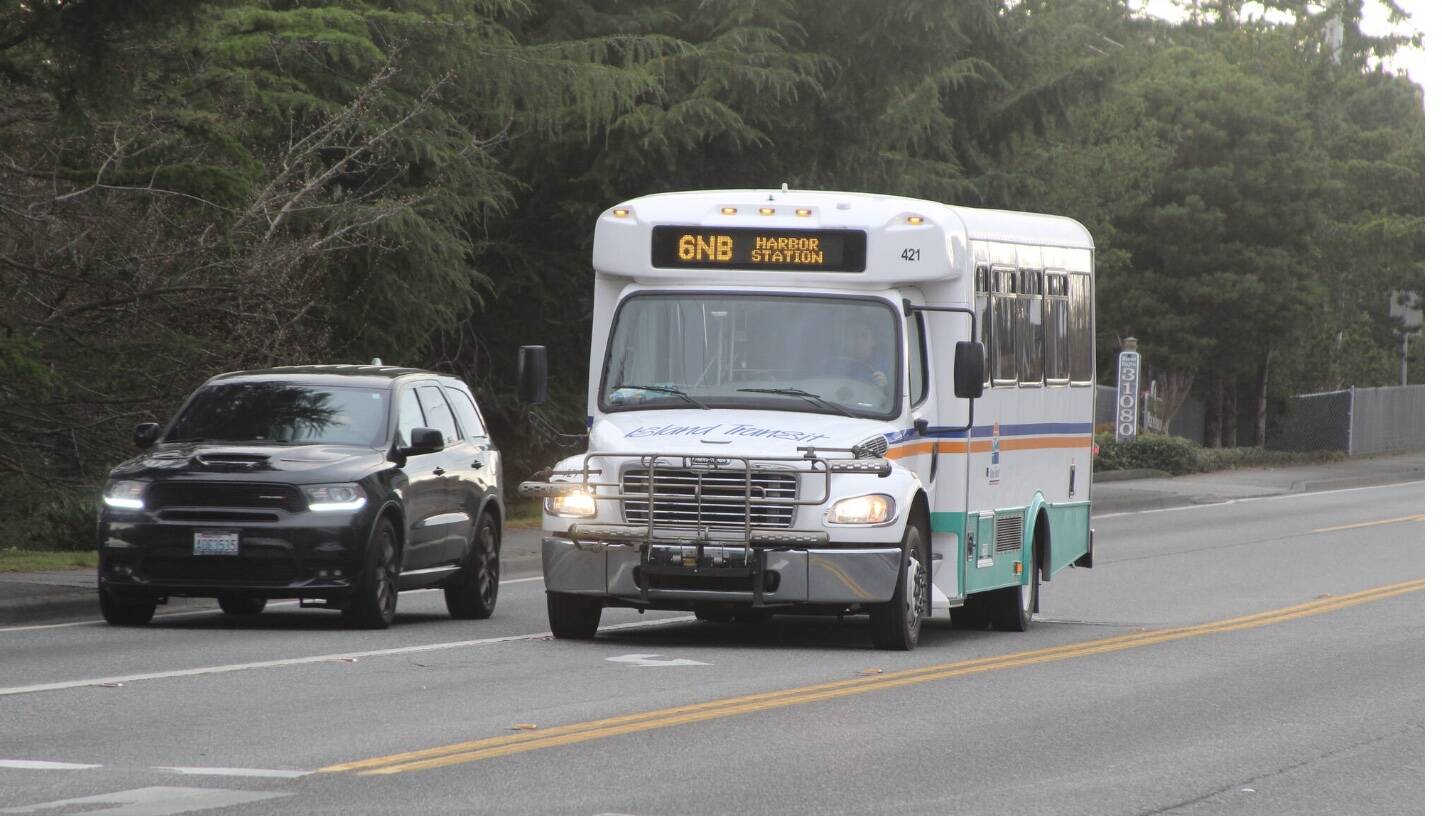
Bus drivers and dispatchers who work for Island Transit received a large wage hike under a new agreement between the union and the agency.
The agency will easily afford the sizable raises and is projected to have a cash reserve balance at the end of 2026 of nearly $66 million, even with $13.6 million in capital purchases and projects.
The Island Transit board of directors adopted the three-year contract with Amalgamated Transit Union, Local 1576 in a 5-1 vote earlier this month. Island County Commissioner Jill Johnson was the only board member to vote against it.
Under the contract, the union members received a 17% wage adjustment, plus a 3% cost of living increase. They will get another 3% cost of living increase next year and another 3% the year after that, according to members of the Island Transit board.
With the raises, the starting wage for transit operators is now at $27.70 and the individual would earn $37.78 an hour after eight years on the job. The starting wage for a dispatcher is $29.35 and the hourly wage after eight years is $39.79, according to the new wage grid. The wage grid does not include “longevity pay” for continuous service.
During the meeting, Island Transit Executive Director Melinda Adams said the contract is a step toward repairing the relationship between management and the union, a process that began when she was hired a year ago. Early in 2024, the board unanimously voted to terminate the former director after revelations that he didn’t clearly disclose that giant raises for some administrative positions were included in the budget; the HR director was fired a few weeks later. The board subsequently became aware of widespread morale problems and hired a consultant who described an unhealthy work culture and a lack of confidence in leadership.
“We have come such a long way,” Adams said. “Today we enjoy a strong partnership in a ‘we’ environment. We continue to improve our culture on a daily basis, and I would like to commend everyone on our efforts to rebuild our relationship.”
Adams said the raises bring the salaries closer to those at similar agencies in the region. Still, she acknowledged that the wage increase was significant.
“It is not a common figure that is normally offered during negotiation process,” she said, adding that future negotiations will likely not look the same.
“We will move forward together in a more collaborative way and in solid partnership,” she added.
The board of directors for the public transit agency is made up of elected officials from other governmental entities. The six members are all three county commissioners — Johnson, Melanie Bacon and Janet St. Clair — as well as Oak Harbor Councilmember James Marrow, Coupeville Town Councilmember Jenny Bright and Langley Councilmember Craig Cyr. Union representative Dani Julien is a non-voting member.
The members of the board adopted the contract after returning from a closed-door executive session. Johnson did not say publicly why she voted against it, and the other members did not discuss their reasons for approving the contract. The board also did not publicly discuss the details of the wage adjustment or the overall cost to the agency. The contract wasn’t included in the agenda posted online.
After the vote, Johnson sent a comment to the News-Times about the contract.
“Buying loyalty isn’t courageous, it’s transactional,” she wrote. “Courage is respecting your employees and the work they do, while still acknowledging that these are hard earned tax dollars and good stewardship of those dollars is a responsibility … and it doesn’t always make you popular.”
Bacon, on the other hand, said in an interview that the wage increase merely puts the drivers and dispatchers on par with other transit agencies in the region. Community Transit in Snohomish County, for example, is advertising a starting salary of $33.54 an hour with the potential of up to $39.31 an hour. In addition, the agency offers a $5,000 sign-on bonus.
Island Transit will have no problem affording the raises. The agency is projected to have a cash reserve balance of $73.8 million at the end of the year, which is massive for an agency with annual operating expenses of $24 million. In fact, the 2026 budget draft discussed during the same meeting shows the agency will net $4.3 million in operating revenues next year but that will be offset by spending for capital projects.
Island Transit will receive an estimated $19 million in sales tax revenues next year, plus $7.7 million in grants.
Capital projects next year will cost an estimated $13.6 million while capital revenues are $1.47 million next year. Overall, the cash reserve balance is projected to be reduced by $7.9 million next year, with an ending cash reserve balance of nearly $66 million.
Some of the large capital projects planned for 2026 include the purchases of two large hybrid buses for more than $2 million, 18 vanpool vans for $1 million, five administrative vehicles for $440,000 and a single-ton work truck for $400,000. In addition, a $1.2 million operator facility is planned for Terry’s Corner, electric transformer upgrades will cost $1.1 million, and a project to fix the HVAC system at the transit facility will cost an estimated $750,000.
An earlier version of the story inaccurately stated that the Island Transit board members did not receive copies of the draft contract before the meeting. In fact, the contract was emailed to board members prior to the meeting, although some board members missed it. They all saw the contract before voting on the matter.