Drones could bolster fire department responses
Published 1:30 am Friday, February 20, 2026
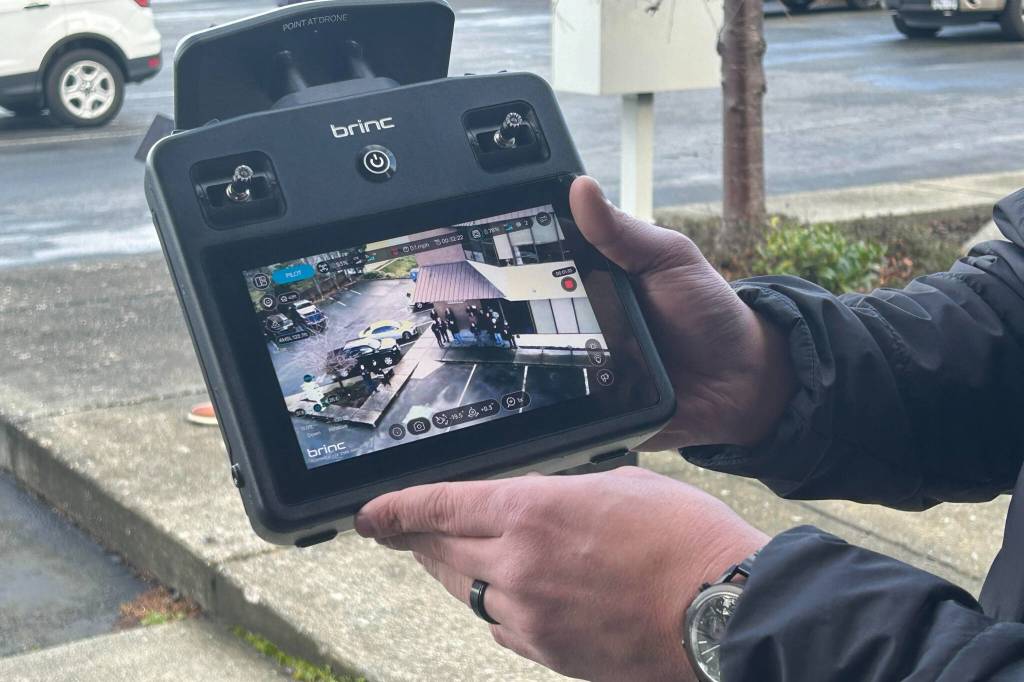


Drones’ efficacy despite Whidbey’s rural terrain, inclement weather and military-obstructed airspace needs to be proved before a North End fire department fully implements them in emergency responses.
North Whidbey Fire and Rescue is considering entering a contract with BRINC, a privately funded Seattle-based start-up creating drone hardware and software expressly for public safety agencies. Company representatives Jeff Hunlock and Joe Schmidt gave a presentation at a board meeting on Tuesday, introducing the technology to commissioners, Chief Chris Swiger, Deputy Chief Ray Merrill and other department personnel.
“No two agencies are the same the way they deploy their drones,” Schmidt said, speaking to their versatility.
More than 700 public safety agencies across the country use BRINC drones to do things like deliver emergency payloads, including Narcan and AEDs, respond to 911 hangups and locate missing persons. Equipped with daytime, nighttime and thermal cameras, drones can also be used to investigate calls before help arrives, better informing the agencies’ responses.
Schmidt estimated 80-85% of the agencies currently using BRINC drones are law enforcement agencies.
North Whidbey Fire and Rescue personnel said they would likely find drones most useful for search and rescue missions. The department’s jurisdiction stretches from Deception Pass to Libbey Road, territory including forested areas where hikers often get lost or injured and need help.
BRINC boasts an emergency response time of just 70 seconds for its drones, able to automatically launch from their dock and fly directly to the coordinates of calls received by dispatch. They fly via cell service and radio frequency, however, cell service can be unreliable around Deception Pass.
Fully charging the drones’ lithium batteries takes about 45 minutes. While the drones can fly to calls within a five-mile radius, going that far may deprive them of the battery life needed to adequately respond to the call before returning to their docks.
North Whidbey Fire and Rescue, however, serves 55 square miles excluding Oak Harbor and Naval Air Station Whidbey Island. Department personnel discussed the possibility of installing docks at multiple fire stations so drones could cover a larger area.
BRINC drones can handle snow and freezing temperatures, less of a concern with Whidbey’s temperate climate. But Schmidt explained that the drones’ battery life struggles against wind gusts greater than 35 mph, and while they are able to fly in fog, the Federal Aviation Administration disallows flying them when visibility is less than three miles. Fog and wind are common on the island.
Schmidt said navigating around the Navy base, located in the heart of the department’s area of service, would be a “hurdle” as well. Navy airspace is a no-go for unauthorized drones, especially in aircraft takeoff and departure areas. Earlier this month, base defense systems downed a drone which had been flown on base without authorization.
Schmidt suggested BRINC could petition the FAA and local Air Traffic Control to increase viable airspace for the drones around those takeoff and departure zones. Something similar is done with agencies located near airports.
Agencies can run a year-long trial of BRINC’s drone technology at no cost — even if the drones are damaged — before financially committing. The technology could run them around $60,000 or $80,000 annually depending on the drone program North Whidbey Fire and Rescue selects.
A trial year could provide the department enough time to secure grants to help fund the drones, if it decides to commit to them.