Amending property agreement could create ‘legal risks’ for town
Published 1:30 am Friday, April 17, 2026
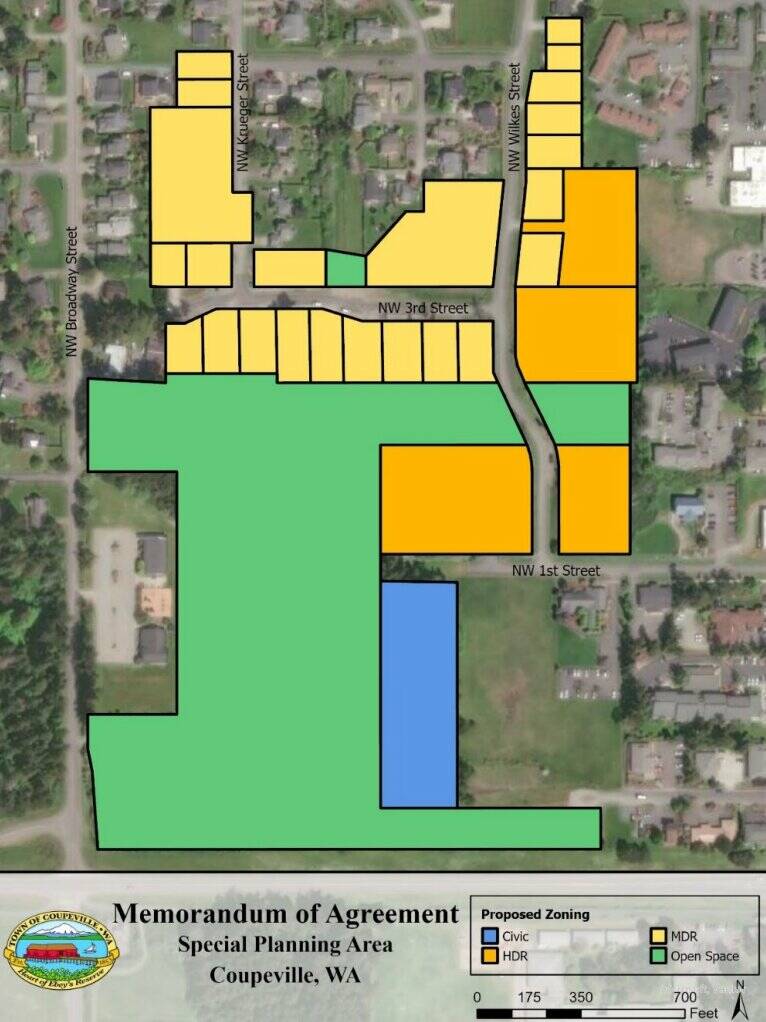
Amending a memorandum of agreement dictating the zoning of a 33-acre property north of Highway 20 between Main Street and Broadway Street in Coupeville is now understood to create “legal risks” for the town, according to a staff report.
Town officials spent months devising an amendment which could increase the land’s currently limited capacity for housing. But staff recently identified state law which prevents amending existing agreements in ways which would be inconsistent with current state zoning regulations, like the one the council hoped to implement.
The memorandum, agreed upon between the town and Cecil and Cheryl K. Stuurmans in 2004, permitted a set number of units to be built on the land through the allotment of dwelling credits. It is protected in its original form by RCW 36.70B.170, according to staff.
”However, if we amend it, it all of a sudden becomes a new agreement,” Community Planning Director Josh Pitts explained during a discussion at Tuesday’s meeting. “And we have to be current to state laws.”
Last time the council discussed the issue, it decided to pursue what a prior staff report described as a “balanced and incremental” amendment to the agreement. Of the six potential amendments proposed, council members preferred one which would increase the land’s housing capacity through the allowance of duplexes and a single accessory dwelling unit, or ADU, on all parcels.
But “new requirements under the Growth Management Act mandat(e) the allowance of up to two ADUs per residential lot,” according to the staff report.
Staff recommend extinguishing the memorandum.
Eliminating the memorandum would subject the land to the town’s zoning and development regulations, creating consistency within Coupeville and with state law, the staff report details. Besides aligning with state law, it would allow the town “to meet its housing and planning goals more effectively” than the memorandum allows, it adds.
“I think if the intent was to meet our long-term housing needs, and to try to do things the balanced way, unfortunately, the actual (memorandum) itself is now getting in its own way,” councilmember Evan Henrich said.
Staff recommend that four parcels within the memorandum area be zoned high-density “to continue to reflect their original intent to concentrate density” if the memorandum is extinguished, the staff report explains.
Councilmember Jenny Bright felt uncomfortable with the possibility of high-density zoning if the affordability of whatever is developed there could not be guaranteed. The way Henrich saw the issue, eliminating the memorandum gives the workforce a “better shot” at affordable housing than they have now.
“And it’s hard. I don’t think it’s guaranteed, but I don’t know of any other way,” Henrich said. “I know if we don’t build more, it won’t happen.”
Long an advocate for maintaining the memorandum, Mayor Molly Hughes “grudgingly” supported its elimination, pointing out that affordability is not a guarantee with any new development. She added that the memorandum area is not the only option for new housing developments.
The memorandum issue could arise again during a public hearing in June, according to Pitts.