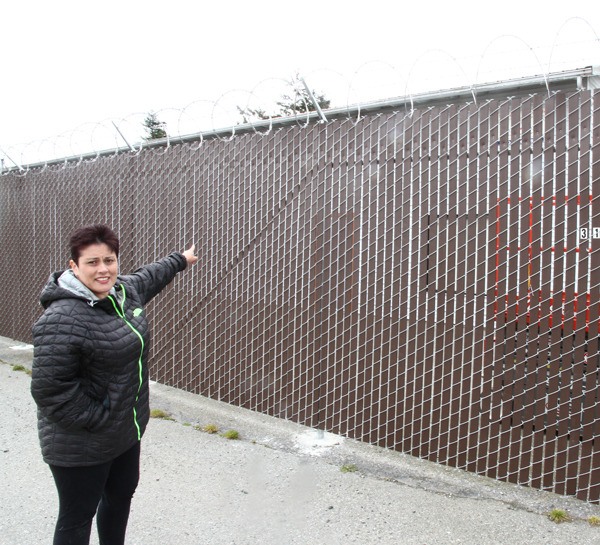
Island County Hearing Examiner Michael Bob-bink is expected to issue a permit within a week, giving marijuana harvesters in Oak Harbor’s industrial area permission to do what they’ve been doing for two years.
The Board of Com-missioners Wednesday concluded it will take no action to halt the pending issuance of a land-use permit to the large Oak Harbor recreational marijuana-growing and -processing operation.
As long as two years ago, the owners of seven buildings, between 3143 and 3171 Goldie Road, without such a permit, converted some of the buildings from commercial retail use to marijuana use. They ejected several retail businesses in the process, and their own multiple tenants have freely engaged in the marijuana business since.
The facility’s owners, Christina and Scott Hensrude, of Woodinville, filed for a land-use permit in 2014, but just had their requisite site plan review hearing on April 15.
After discussing the situation, the commissioners on Wednesday explained that, if you want to undertake a lawful activity or project in Island County, there’s no need to get a county land-use permit first. You may freely proceed with your plans.
If someone complains — and only filing an official complaint will suffice — then the county will give you 45 days to file for the permit. If you do so, no penalty will be imposed, and the permit will not be withheld.
If nobody complains, you are free to continue your unpermitted use indefinitely.
“Our effort is to get people to move toward the right building permits and land-use permits to get compliance,” Hiller West, the county’s director of current-use planning and community development, said at the meeting. Punishment is not part of equation.
Here’s where the confusion occurs. In past instances, some residents failing to first obtain land-use permits were issued stop-work orders until they obtained one. Others waited to proceed until they got their permits, out of fear and respect for how they believed the law is enforced.
For example, because she lacked land-use and building permits, recreational marijuana retailer Maureen Cooke in 2014 was hit with a stop-work order while preparing to open her South Whidbey store.
Obtaining those permits cost Cooke $2,500 and delayed her opening by four months.
Lucas Jushinski waited six months, spending more than $6,000 in rent on an empty storefront and $2,000 in insurance while waiting for Island County to issue a land-use permit for his recreational marijuana retail store in Freeland.
“I didn’t want to live in fear of the county coming in and closing me down,” he said.
Jushinski just opened his store.
It’s clear that some county residents seek to find, understand and follow the law, while others are ignorant of the law or flout it, said County Commissioner Jill Johnson.
The root of the problem is that the county currently doesn’t treat those two groups differently, she said.
“What do we do to distinguish between those types of behavior?” she asked rhetorically during an interview Thursday. “We need different mechanisms to deal with them, because right now people who follow the rules are being put at a distinct disadvantage, and we want to encourage rule-following.”
As to the outcome in the current situation, with apparent scofflaws getting away with it, Johnson said, “It’s just lousy. It’s a lousy situation.”
The outcome “is frustrating, because (the law) is inconsistent in its application,” agreed Commissioner Helen Price Johnson on Wednesday. “If one person has a neighbor who complains and another doesn’t, and they’re doing the same activity — that’s the crux of the problem in how we’re going about this right now.”
Price Johnson said a discussion of rural land use, scheduled for next year, might lead to changes.
Surprisingly, one person who followed the law said he is happy others did not.
“I’m glad the Oak Harbor guys just went ahead and did what they wanted to do,” said Jushinksi, the pot retailer. “The county wants to get its hands into everything, and it takes forever to do anything.”
Enforcing land-use and building laws by encouraging compliance, rather than by punishing non-compliance, is probably common in this state, said Josh Weiss, general counsel for the Washington Association of Counties.
“My anecdotal sense is that most counties would take the compliance approach, at least at first and probably only up to a certain point,” he said.