
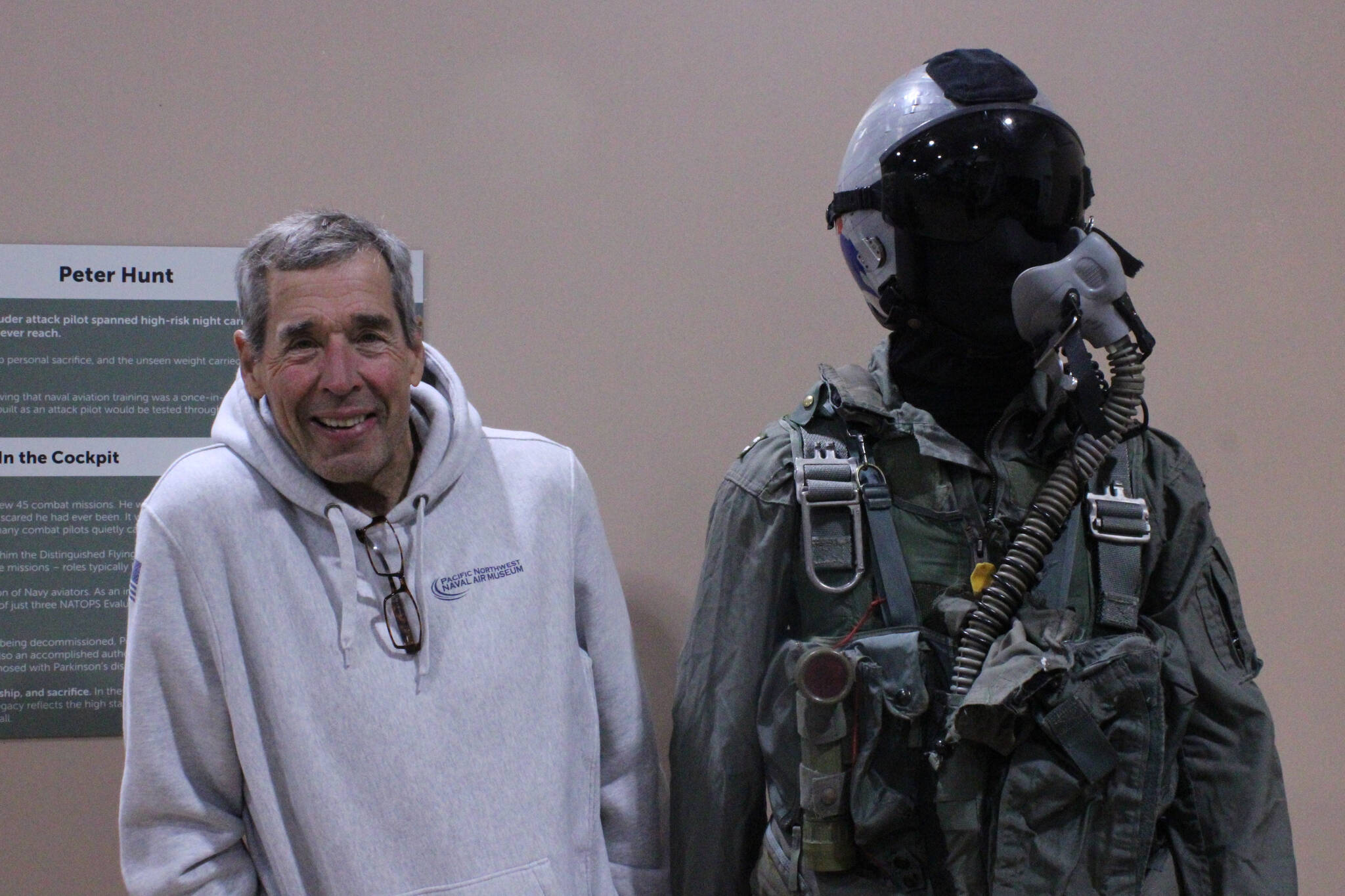
Recovering the ruins of a plane wreck helped a Whidbey veteran and author attempt to rediscover himself.
Peter Hunt’s experience as a Navy attack pilot and his battle with Parkinson’s disease informs his new documentary, “Lost Intruder,” which details his journey to salvage an A-6E Intruder from the waters of Rosario Strait.
The documentary is nearly finished — a trailer could be released this week — and aligns with the release of the second edition of the book which inspired it, Hunt’s “The Lost Intruder: The Search for a Crashed Navy Jet, Parkinson’s Disease, and What it Means to be Alive,” not long after the 10th anniversary of the jet wreck’s positive identification.
A three-month search by the Navy failed in finding the jet, according to previous News-Times reporting, which crashed shortly after departing Naval Air Station Whidbey Island in 1989. Hunt, who flew Intruders during his service, felt compelled to produce the documentary because of the jet’s personal significance to his life.
“I don’t believe in closure in life,” he said. “But (the documentary) is pretty close to it. And I think it’ll help put me at ease when my situation progresses.”
Hunt enlisted in 1985, and his decade of service included flying 45 combat missions as part of Operation Desert Storm. Once he retired in 1995, he worked as a commercial pilot for United Airlines for 10 years before receiving his Parkinson’s diagnosis at the age of 43.
“I was grounded for the medication I was on, and I was without a job and couldn’t fly anymore,” Hunt said. “So that was a little bit of an eye-opener.”
Artistic expression’s importance to Hunt’s life cannot be understated. He penned five books about his service and today, he regularly blogs about his day-to-day life and his quest to find meaning in the ordinary. But the producer credit he will earn from “Lost Intruder” will be his first.
The documentary includes interviews with the divers who visited the submerged ruins as well as footage of the ruins itself.
“We got video of it. We had two videos, two 20-minute videos of the whole thing — landing gear, cockpit area, one engine cowling, both engines, tails intact,” Hunt said.
Hunt’s path and the Intruder’s are somewhat intertwined. He explained experiencing “synchronicities” related to the jet’s recovery and the subsequent filming of his documentary — like meeting a fellow Navy veteran at his sons’s orthodontist appointment who had “worked” the A-6E Intruder crash.
Ultimately, when it comes to finding meaning in life, Hunt hopes the viewing experience will be as personally enlightening as the jet discovery and documentary have been for him.
Meet Hunt at his book signing from 2-4 p.m. on Friday, Oct. 24 at the Pacific Northwest Naval Air Museum.

