City may annex 80 acres as part of planning update
Published 1:30 am Friday, December 19, 2025

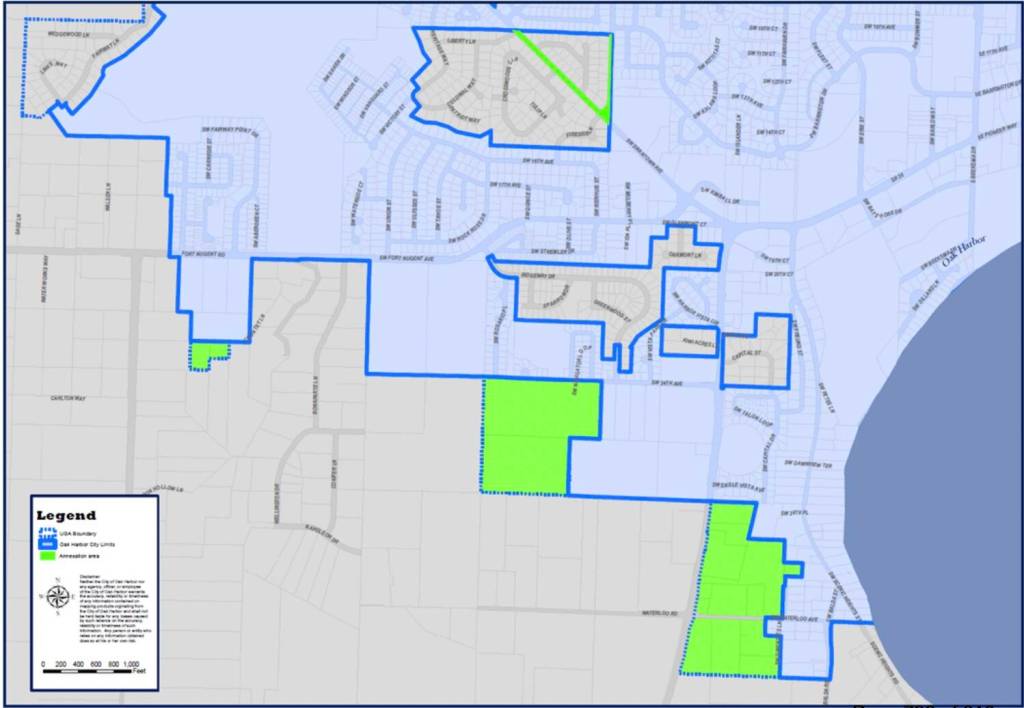
The city of Oak Harbor may grow by 80 acres under a proposed interlocal agreement with Island County that’s part of the ongoing update to the comprehensive plan.
In addition, officials in the city and county are moving forward with adopting a new, lower 20-year population projection for the comp plan updates in order to decrease projected future growth in Oak Harbor. The new population numbers won’t be finalized unless two of the three municipalities on the island also adopt it; the population change will not affect Langley and Coupeville.
The major proposed changes coincide with Island County completing the draft comprehensive plan update, which will guide development and growth in the next 20 years in ways that will have real-world implications, especially for the city of Oak Harbor. After countless hours of meetings and analysis over the last couple of years, the county’s draft update is available for public review and comment online as www.islandcounty2045.com.
As part of the comprehensive plan update process, the Oak Harbor and county leaders are moving forward with a proposed first-ever, large-scale annexation governed by an interlocal agreement. This week, both city council members and county commissioners discussed the proposal, which would annex 80 acres of undeveloped or underdeveloped property within urban growth areas south of city limits into Oak Harbor. The annexation, which is part of the comprehensive update process, will increase population capacity in the city by adding an estimated 257 housing units .
At a county commissioner meeting Tuesday, Emily Neff, assistant director of long-range planning, said that the change in the population projection is “an imperfect solution” to a disagreement between county and Oak Harbor planners. County planners, as well as commissioners, believed that the city’s plans to expand the urban growth area, or UGA, by a minimum of 222 acres — or as much as 434 acres — and place much of the low-income development in the UGAs required the city to plan for serving those areas by extending infrastructure; city planners disagreed, explaining that the city’s policy is for developers to fund infrastructure expansion.
As a result, the lower population projection means the city will likely not be able to expand its urban growth area as part of the update process, although city and county planners agreed to work together to develop a framework to resolve long-standing issues regarding urban growth areas in the future. Only property in a UGA can be annexed into the city.
The county and the three municipalities on the island are in the process of updating their comp plans, which are policy documents that guide development over the next 20 years. The plans are mandated under the state Growth Management Act, which aims to guide development in a way that is environmentally responsible, economically sustainable and socially equitable. A cornerstone of the plan is to avoid urban sprawl by increasing housing densities inside cities and places with urban infrastructure.
Under the Growth Management Act, counties and cities are supposed to consult to set UGAs, which is land in unincorporated areas earmarked for annexation into cities; property not within UGAs cannot be annexed into municipalities. The process of setting UGAs is meant to ensure growth happens in a planned, compact way.
Comp plans need to be updated every ten years. Prior to this round of amendments, state lawmakers amended the Growth Management Act to require local governments to plan and accommodate housing affordable at all income levels. In addition, new rules push even more population growth into urban areas….
The first step in the amendment process was for the county and each municipality to adopt population projections. The state offers three different projections — high, medium and low. Early in 2024, the county and municipalities adopted the medium population projections that sets the current 87,000 people to grow to nearly 103,000 in 20 years.
Under the state’s direction, the bulk of the housing for population increases should be planned for urban areas, which in Island County largely means Oak Harbor. The city initially agreed to take 63% of the growth.
Under law, the county is responsible for setting UGAs, with consultation with cities, according to the Municipal Research and Service Center. If there’s a challenge to a UGA expansion — which has happened before — then the county is responsible for defending the decision before the Growth Management Hearings Board and possibly in court.
Over the last year, county and Oak Harbor officials disagreed about a couple of issues related to accommodating the growth of workforce housing in the city. While the city wanted to place most of the workforce housing — which usually means apartments or other multi-family housing — in the UGA, county officials argued that the city should accommodate more of that kind of housing within the city through rezoning.
In February, the commissioners, city council members and other city officials met in a meeting over the issues. In the end, the council members agreed to complete more rezoning for higher densities in portions of the city.
Later, however, the city and county planning staffs reached an impasse over a related issue. County planners argued that the city needed to create plans for expanding city infrastructure — water, sewer, roads and so on — into UGAs in order serve the residents. City planners disagreed, arguing that it was up to developers to extend infrastructure.
City and county staffs initially set up another meeting between the commissioners and the city council to discuss the disagreement. The commissioners canceled the meeting, saying that it was clear from the previous meeting that some of the Oak Harbor elected officials didn’t understand the complex issues and that a meeting wouldn’t accomplish much.
County officials ultimately decided that the best option was to lower the population allocation, which means the UGA will likely not be expanded and a capital facilities plan is not needed for the expanded UGA. Under the ordinance adopted by the commissioners, the 20-year population projection was reduced from 102,639 to 99,202. All of the reduction will be in Oak Harbor, which is still taking 55% of population growth, Neff said.
During the meeting Tuesday, Island County Commissioner Jill Johnson stressed that the comp plan process is an imperfect, aspiration exercise that can’t completely control development or population growth.
“The reality is, even with these plans, people are going to go where they are going to go,” she said.
In addition, the city and county agreed to pursue an interlocal agreement to annex nearly 80 acres of existing UGA into the city; the land represents a probable population capacity of 257 units based on city zoning.
During a meeting this week, Senior Planner Cac Kamak presented a draft to the council and explained that affected residents will be notified of the potential change. The issue will return to the council at a later date.