Whidbey fire chiefs call for greater transparency in insurance rating system
Published 1:30 am Friday, June 12, 2026
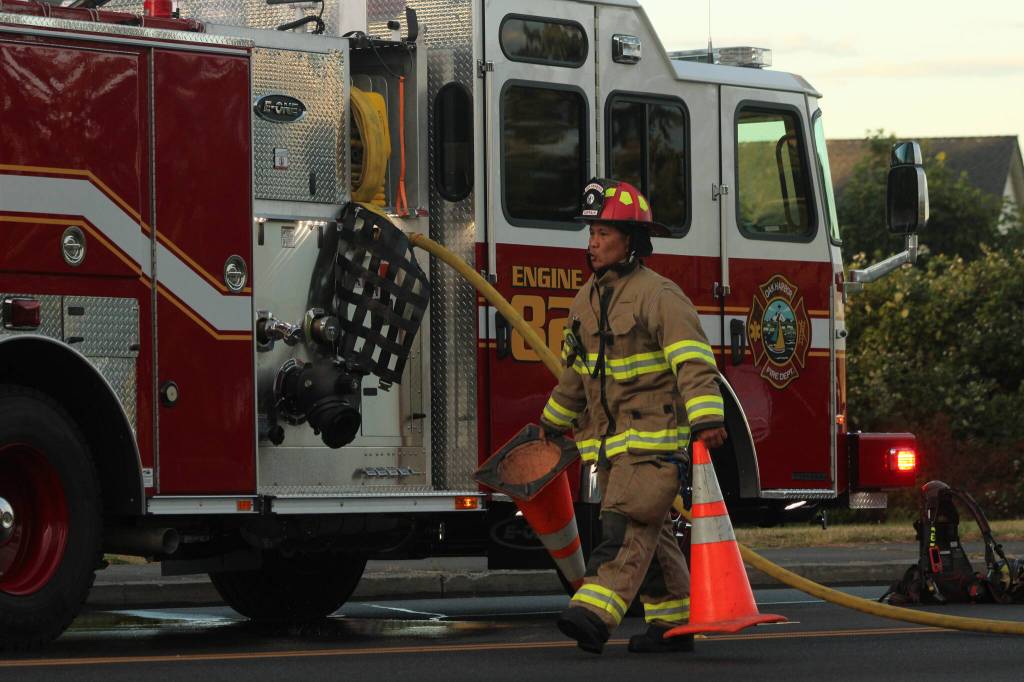
Firefighters on Whidbey support efforts to improve how fire departments are evaluated, but say key gaps in the system — including a long-missing county fire marshal — are overdue for attention at home.
“Everybody’s got to play together for an improved system,” Chief Nick Walsh of South Whidbey Fire/EMS said.
Insurance companies commonly use protection class ratings — administered by the independent Washington Surveying and Rating Bureau every five years — to set fire insurance premiums. But an assessment of the bureau’s methodology, requested by the state Legislature, found it to be opaque, inadequately performance-based and disadvantageous to rural and volunteer departments, among other things.
And when ratings dip, premiums tend to rise.
The Office of Insurance Commissioner contracted a group led by a former U.S. Fire Administrator to conduct the assessment over five months beginning in late 2025. Insurance Commissioner Patty Kuderer delivered the report to members of the Senate and House insurance committees on May 28.
“Growing concerns about equity — particularly for rural communities, volunteer departments and wildland-urban interface areas facing an insurance access crisis — provided the primary policy motivation,” the report states.
While the report acknowledges a few of the rating system’s strengths, like the consistency it creates statewide in the evaluation of departments, it recommends reworking it and filling in “key legislative and regulatory gaps” in a supplement.
Meanwhile, fulfillment of Whidbey fire chiefs’ longstanding desire for the county to hire a fire marshal — a position they said has been vacant for decades — would go a long way in improving fire service on the island.
Increasing transparency of ratings is, according to the report, the “highest priority among fire service professionals statewide.”
Depriving departments of the ability to understand how their ratings are calculated, as the report found the bureau’s rating system does, makes using ratings to guide improvement difficult. Notably, the report states, the bureau declined to provide “raw scoring data and detailed point-value calculations” for the assessment.
“(The bureau has) a guide and they will tell us basically what we’re being rated on as a district,” Walsh explained. “However, they don’t give us the details. In other words, they’re working off a spreadsheet that determines your score and we don’t get to see that.”
Bill Harris, deputy chief of the Oak Harbor Fire Department, emphasized that the standards themselves need to be more “clear” and “objective” as well, so there are fewer doubts about how departments should spend taxpayer money to meet them.
According to the report, the rating system relies on “outdated rules” and prioritizes “completing forms over actual operational performance.” Harris agrees it could be more performance-based, but added that the subjectivity required could reintroduce the same problems the system already faces.
“Effectiveness is only really measured by the number of firefighters assembled,” he said. “While the number of firefighters assembled matters, the skill and tactics they employ matter more. The recommended ‘performance-based metrics’ make sense to me, though I see difficulty in establishing these metrics without additional subjectivity.”
Rural and volunteer departments are disadvantaged, according to the report, in standards related to staffing, equipment age and more. Jerry Helm, chief of Central Whidbey Island Fire and Rescue, Walsh and Harris disagreed that these agencies are unfairly rated.
But there are still “antiquated” elements of the rating, as Walsh described them, which may benefit from modernization. Helm recalled his district losing points during an evaluation because it lacked a designated area to dry fire hoses. Most modern fire hoses are made of materials which don’t need to dry, he pointed out.
“And that’s such a small, small fraction of our rating, but all those little things like that add up,” Helm said.
Holding other entities accountable when they fail to comply during evaluations would be beneficial, too.
Ratings fundamentally rely on information from entities like dispatch centers and water purveyors to get the full scope of a community’s fire suppression capability. Given that ratings fail in “distinguishing rated components within fire department control from those outside of it,” the report reads, departments can suffer the consequences of failing to fulfill responsibilities which aren’t theirs.
Central Whidbey Island Fire and Rescue has previously had difficulty obtaining this information for evaluations, and Helm specifically recalled issues with water purveyors providing “decades old” data or having to request it multiple times.
“The fire departments don’t really have a role in a couple major portions of how we’re graded,” Helm said. “And I assume the smaller you get as an organization, the less and less influence you have in those areas that you don’t have any control over.”
North Whidbey Fire and Rescue is still contesting its most recent rating on the grounds that the bureau administered it without receiving all necessary information from the county and relevant water districts. Chief Chris Swiger previously called the outcome “disheartening.”
Island County has since submitted necessary information related to fire building inspections to the bureau, Swiger told the district’s board of commissioners during a June 9 meeting, resulting in a slight but ultimately insignificant improvement in the rating.
Walsh stressed that departments on Whidbey are as dependent on the county in some ways to perform well in the bureau’s evaluation as they are dependent on water purveyors and others.
Fire marshals are responsible for ensuring compliance with fire codes, and without someone in that position, departments on Whidbey are also without an “investigative authority over questionable fires,” Helm explained. He added that his district has trained some firefighters in fire investigation to fill that gap in service, but ultimately it is not their responsibility.
Helm and Walsh described the county fire marshal’s responsibilities as being consolidated with the sheriff’s. Fire chiefs on Whidbey have tried to push for the hiring of a dedicated fire marshal, to no avail.
“I know I can speak for all the fire chiefs on the island and say having that position filled would be huge for all of us,” Helm said.