Ideas growing for use of felled Garry oak tree
Published 3:42 pm Friday, February 6, 2015
Giant acorns. Furniture. Paneling. A ring-count display.
An ad hoc committee charged with making recommendations about what to do with the wood from the post office Garry oak tree presented a long list of ideas at an Oak Harbor City Council workshop last month.
The council is scheduled to consider the proposals at a meeting in March.
It could be a lively discussion. Councilwoman Tara Hizon said she wanted to make sure the council had time to hash out the recommendations.
“I have, predictably, a number of opinions about the options that you put forth,” she said.
Last March, city crews cut down the landmark, 330-year-old Garry oak tree that stood next to the post office. City officials claimed the tree was a safety concern, but the felling angered many residents who felt the decisions shouldn’t have been made in secret.
Afterward, the city put together a committee to come up with recommendations for the wood.
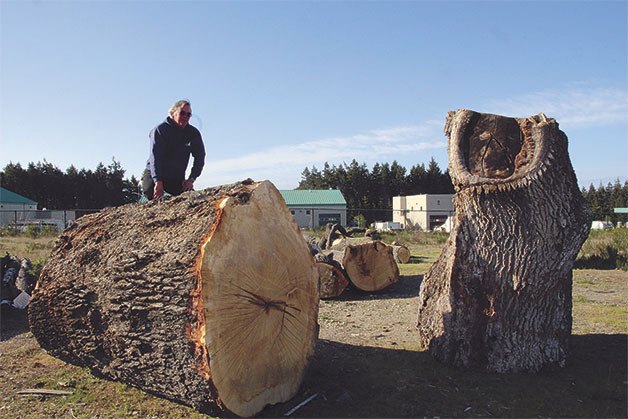
And a lot of ideas are needed. The wood from the humongous tree translates into about 4,320 board feet, and that doesn’t even include the secondary limbs, according to Brad Gluth, a civil engineer with the city.
The members of the ad hoc committee include Jeff Daugherty, a local wood miller; artist Brandon Davis; Nora O’Connell Balda, a member of the arts commission; and Ana Schlecht, a planning commission member.
In addition, City Parks Manager Hank Nydam and Gluth are staff members on the committee. They gave a PowerPoint presentation to the council that included photos to help illustrate the idea; Gluth emphasized that the images don’t represent exactly what the committee proposed.
The goal of the committee was to “utilize the wood from the post office oak tree in a manner that will commemorate and honor the tree for current and future citizens of Oak Harbor.”
About a decade ago, the City Council hired an artist to turn the trunk of the tree into a totem-pole-like carving, but then the council decided not to cut the tree.
Nydam explained that a totem pole design wasn’t really possible anymore because the main trunk of the tree was cut in two. The crane used to carry the wood couldn’t handle the weight of the entire trunk.
Instead, the committee proposes many smaller projects.
Gluth said the members felt that most of the wooden works should be kept indoors to preserve them for the long haul. He said flat surfaces like benches wouldn’t last very long outdoors.
The committee proposes that much of the wood can be incorporated into the city’s new sewage treatment plant, which officials refer to as the “clean water facility,” Gluth said. The plan is to have an interpretive area and a meeting room in the new building.
The wood may be used architecturally in the building and made into furnishings, he said. The use of the wood could be incorporated into the budget for the plant project, which will be funded by sewage utility fees.
In addition, the committee proposed that other pieces could be displayed at city hall, the library, schools and other publicly accessible buildings. Gluth said the city would have to look into different ways to fund those pieces.
One of the few outdoor projects they proposed was a ring-count display, possibly at the tree’s former home next to the post office. A section of the main trunk would be displayed so that people can see the tree rings; different events in history would be highlighted in the tree’s life.
Gluth said the presentation could be built so that the wood is protected from the rain.
Another idea is to hire artists to carve giant-sized acorns. He said the curved shape of the acorns would prevent rain from pooling, so it would be OK outside with a good coat of sealant.
Ideas for indoor projects included a giant slab table.
“We really wanted to emphasize the size and the magnitude of the tree,” Nydam said.
The committee also proposed benches, podiums, doors, wall tables, wood paneling, counters, animal sculptures, display cases and even plaques.
Gluth explained that Garry oak, which is a type of white oak, is dense wood with a unique, swirly grain that makes attractive furniture.
In addition, Nydam said the committee members and others recommend that a unique limb formation, which he described as “a big old giant claw,” be used in an artistic way that keeps the shape intact.
Nydam said the presentation didn’t touch on all of the ideas. He said the “sheer volume of wood” means that the city will have plenty left over for smaller items, such as coasters and wooden pens.
The wood is currently in a pile on boards at the city shop. Nydam said the committee recommends that the city purchase “metal roofs” to shelter the wood over the next couple of years. The shelters can be used to protect city equipment after the wood is gone.