Civilian Conservation Corps boys built for the future
Published 9:00 am Saturday, April 12, 2003
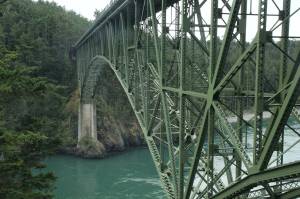
Seventy years ago, about 60 young men from the mean streets of New York ferried across Deception Pass to a camp on the banks of Cornet Bay. For $30 a month, they labored long hours to build roads, trails, rails and impressive buildings in a park that has become one of the most visited in the Northwest.
They were among the first members of a peacetime army called the Civilian Conservation Corps, a Depression-era program that put thousands of poor, young men to work preserving the nation’s parks and natural resources.
About 20 alumni of CCC camps from across the country gathered last weekend for an anniversary celebration at Deception Pass State Park, one of the gems of the CCC legacy. Terry Doran, the regional manager for Washington State Parks, praised the program and the amazing work of the “3-C boys.” They planted 3 billion trees, built 100,000 structures and 50,000 bridges, put in 126,000 miles of roadway and saved millions of acres from erosion during the Dust Bowl.
In return, they were housed, fed and taught important skills. “Three million boys turned into men, leaders,” Doran said. “Many enrolled in the military after Pearl Harbor, where their skills were vital.”
Several of the men told pieces of their stories to an audience of more than 100 people during a presentation at the Cranberry Lake kitchen shelter. The large lumber and stone building, made by the CCC boys, was recently restored through the State Parks’ historic preservation program.
One of the most amazing stories came from John Tursi, an 85-year-old Anacortes resident. He explained how he was among one of the first companies that came to work at Deception Pass. He was just 16 years old when he joined, but claimed he was 21 in order to escape dire poverty and homelessness of 1930s Brooklyn.
He recalled how he and other inner-city boys and street kids were put on a train they thought was headed to Anaconda, an airfield outside of Washington, D.C., but several days later they arrived in Anacortes.
While the wilds of Whidbey Island were like nothing Tursi had ever seen before, he instantly fell in love with the area, as well as the “three squares a day” he enjoyed in the camp. Yet it was Tursi who started a giant food fight at the CCC barracks — in protest of rotten eggs — which led to the Army bringing in a cook to prepare meals.
One of Tursi’s jobs was to blast stumps, rocks or whatever needed blowing up with dynamite, a skill he learned from a Whidbey Island man. The inexperienced kids of the corps depended on such LEMs — Local Experienced Men — to teach them the necessary skills.
One night in Oak Harbor
Tursi said the CCC boys on Whidbey originally went to Oak Harbor for entertainment, which usually consisted of a movie or a dance, but the small town of mainly Dutch farmers wasn’t very welcoming. They went to dances at the IOOF Hall, but few girls would brave dancing with them.
The CCC fellows were eventually kicked out of Oak Harbor, Tursi said, after the Oak Harbor American Legion held a “smoker” — a boxing match between a local and a CCC boy. A bad call by the referee sparked a mini-riot. Tursi said he remembers folding chairs flying through the air and even Oak Harbor women getting into the fight.
Afterward, Oak Harbor officials told the CCC boys not to come back. Tursi said they started going to Anacortes instead, where the townsfolk were a little friendlier. He explained that they were used to young, transient men — like fishermen and factory workers. Tursi eventually met his wife, Doris, in the town and settled there after he volunteered for the Army Corps of Engineers — using his CCC skills — and spent four years in Europe during World War II.
Walt Bailey, a Snohomish County man, told stories about working at a CCC camp in the Cascade Mountains near Darrington. He explained how the federal government paid each man $30 a month, with $25 going home to their families. The men got to keep the other $5, which was raised to $8 in 1937, which they used to buy cigarettes.
Bailey said they built many miles of “truck trails” and hiking trails, hung phone lines, removed fire hazards, built bridges and risked their lives fighting fires.
Bob Robeson, a Wyoming resident and an officer in the national CCC Alumni Association, explained how he was sent to work in Shoshone National Forest for the corps. The young men strung telephone wires and battled forest fires in what would become the first national forest.
He described how the forest was still untamed at the time the men worked there. “Some of the places were so bad the grizzly bears wouldn’t even go there,” he said.
Robeson said the association wants to place a bronze statue of a CCC boy in each state and the organization picked Deception Pass for the Washington site. But first, he said $20,000 needs to be raised.
In order to preserve the legacy of the CCC, State Parks Historic Preservation Planner Gerry Tays explained how the department is using volunteers and park rangers to do preservation work on CCC structures. Yet he was critical of how little state and federal governments have done to preserve CCC projects.
Volunteers save the day
He pointed out that Washington state is the largest owner of CCC structures in the nation, but the state has done “probably the least” to preserve them. He said he had to turn to volunteers to do the needed work.
“If we wait for the states,” he said, “these buildings will fall down around us.”
Tays explained how he put together a program for volunteers and staff members to learn restoration techniques from experts. The idea is that the buildings and other structures should be restored in the same way — mostly by hand — and with the same material that the CCC boys used. A volunteer blacksmith and a woodworker demonstrated their techniques outside the shelter after the ceremony.
Tays said the Cranberry Lake kitchen shelter itself was one of the biggest accomplishments of the new program.The structure, which he described as “a marvel of workmanship,” was restored over the last year. The project participants re-did much of the rock work, replaced rotting timbers and put on a new roof. Tays said they discovered a petrified fish inside a wall, apparently a little present left behind by a 3-C boy.
Tays pointed to many impressive features of the building and he marveled at how the work could have been done without heavy machinery.
“We are all in awe of the workmanship,” he said.