Aerial videography business lifts off for Oak Harbor brothers
Published 5:07 pm Friday, December 26, 2014
As with any business pursuit, there are obstacles to overcome.
For Oak Harbor brothers Paul and Justin Skinner, that obstacle was a span of steel weighing nearly 1,600 tons.
Hovering high above Deception Pass Bridge and capturing spectacular footage with a camera-equipped drone proved to be no problem during a video shoot this summer.
However, using remote control to direct the drone underneath the bridge, where the internet signal disappeared, didn’t turn out so well.
The drone hovered in place for awhile, rose on its own then glanced off a steel truss, sending it spiraling into the swirling waters below.
Their pride hurt but not broken, the Skinner brothers would return to succeed on another day.
“We had to get the shot,” Paul Skinner said. “We went back and conquered our nemesis.”
Paul and Justin Skinner are co-owners of Vivid Aerial Ascent, a new Oak Harbor-based company that offers aerial video and photography for its customers.
Launched this summer, the business caters to events such as festivals, weddings, sports contests, concerts and other occasions with possibilities growing as wide as the Skinners’ imaginations.
The company recently was hired to provide aerial footage of properties for a large Seattle-based real estate firm.
“We are basically a flying camera,” Paul Skinner said.
Getting their business off the ground didn’t come without careful research, an understanding of legalities and attention to rules.
The Skinners needed to navigate through the gray legal areas regarding drone usage and the stigmas attached to the devices themselves.
“The term ‘drone’ has gotten a different kind of popularity over the past year,” Paul said. “We drop the word when necessary. Some people have strong opinions about the word drone. They think of military spying and that sort of stuff.”
Flying unmanned aircraft for recreational use is allowed by the Federal Aviation Administration as long as it follows prescribed weight (less than 55 pounds) and safety rules.
However, the FAA doesn’t endorse commercial usage and has been ordered by Congress to issue national rules legalizing drones for such purposes by September of 2015.
The rules are expected to be revealed early in the year as the FAA projects 10,000 such devices in the U.S. skies by 2017.
The Skinners, whose father is a prominent Oak Harbor attorney, believe their business model to be unique and compliant.
“We are not charging for the service of flying,” Paul said. “We’re charging for content.”
“We charge for our video and photo-editing services,” Justin said.
“We prefer the word cinematography. Video can pertain to home video of a family celebrating a birthday. Cinematography is geared more toward professional video production.”
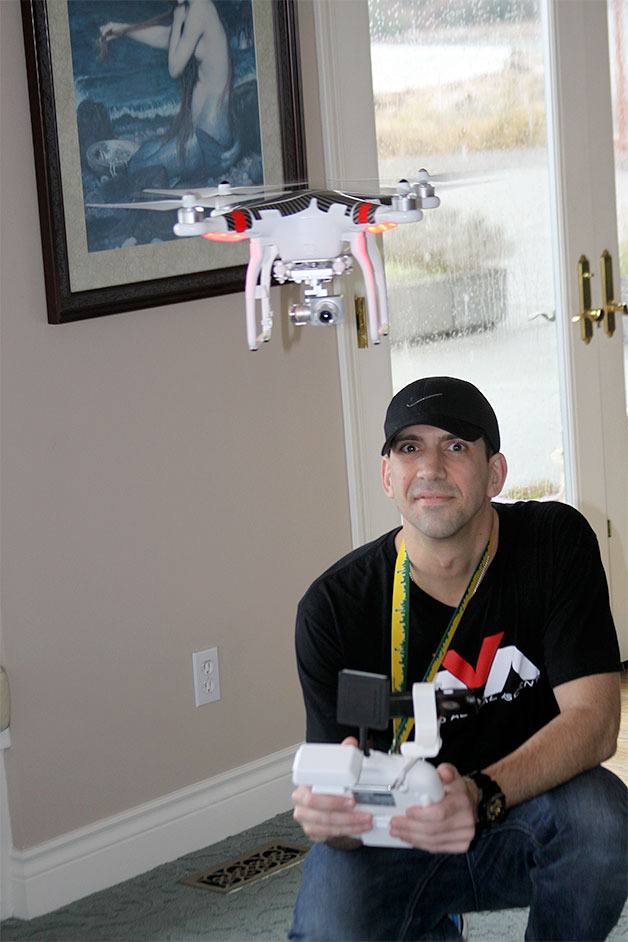
(Below: Justin Skinner at the controls of a quadrocopter.)

Paul, 36, and Justin, 31, are both Oak Harbor High School graduates who tinkered with remote-control devices during their youth.
The idea of launching a business that would provide unique vantage points from the sky came to Paul after watching a motocross event a year ago.
“I took my passion for media and wanted to get into a new emerging field,” said Paul, who earned a degree in multi-media at the Seattle Art Institute.
The brothers own two drones, which are also called unmanned aerial vehicles or UAV’s. They are the same model quadrocopter, a DJI Phantom 2 Vision Plus, which features four rotating blades and an integrated, 1,080-pixel high-definition video camera. They weigh less than 5 pounds and cost about $1,500 apiece.
The Skinners have ordered a yet-to-be released 4,000-pixel, higher-definition model.
“It hasn’t quite hit the market yet,” Justin said. “We really see the market headed that way.”
The Skinners have demonstrated their drones at several public events in Oak Harbor during the summer, including the Oak Harbor Music Festival, Oak Harbor Hydroplane Races and National Night Out.
Well-versed in privacy and safety rules, they know not to send their drone buzzing higher than the FAA’s allowable limit of 400 feet to avoid other aircraft, even though it is capable of heights five times that number. They also must respect a two-mile, no-fly zone around Whidbey Island Naval Air Station, as well as people’s privacy.
“UAV use on a personal level is completely legal as long as you’re respecting the privacy of people’s property or boundaries,” Paul said. “Just like you’re not going to stand in somebody’s backyard with a normal camera.
“Some people say they’re used for spying. That’s like saying that’s what cameras are for.”
For more information about Vivid Aerial Ascent, go to the company’s website at www.vividaa.com.