State Court of Appeals hears WEAN v. Oak Harbor
Published 1:30 am Friday, April 24, 2026
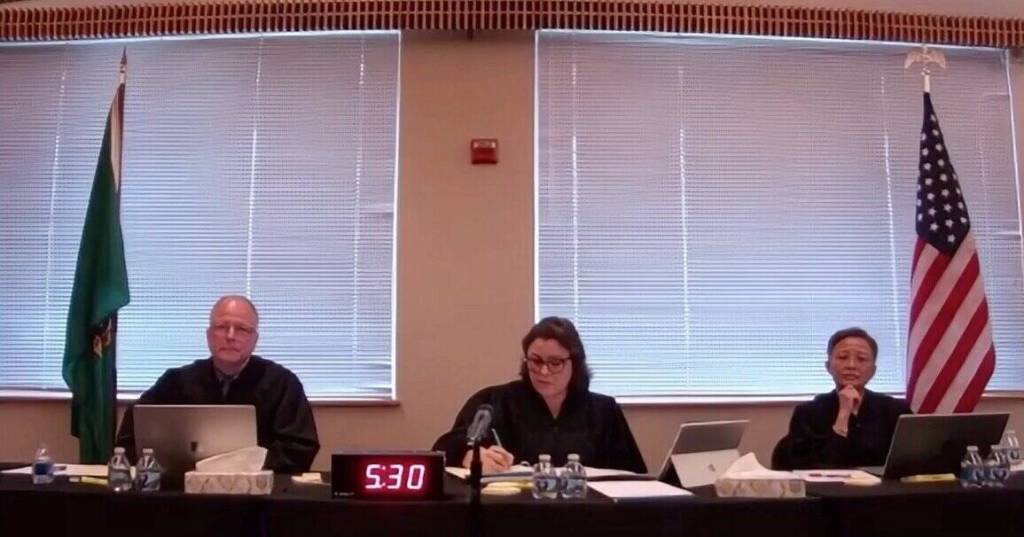
A crowd of Oak Harbor officials and environmentalists gathered Tuesday morning to hear legal arguments in a state Court of Appeals case that may decide whether or not a new hotel will be built in downtown Oak Harbor.
District 1 judges Cecily Hazelrigg, Linda Coburn and Bill Bowman assembled in a packed room at Whidbey’s Skagit Valley College campus. Over the course of the approximately 30-minute hearing, attorneys debated whether the context of an ordinance’s adoption necessitated a review under the State Environmental Policy Act, or SEPA, that the city did not conduct.
Litigation began in August of 2024 when appellant Whidbey Environmental Action Network, or WEAN, sued the city for amending a 1997 city code protecting city-owned parkland from development with the adoption of Ordinance 1999.
Under the ordinance, the city no longer needs a public vote to enter into a development agreement for the purpose of disposing property, a requirement it characterized as having “potential to hinder cooperation between the city and private property owners.” Instead, the council can approve development agreements itself once a public hearing is held.
Notably, the ordinance ensures the city benefits from development agreements it enters. Council adopted it earlier that month.
A central issue in arguments was whether the ordinance qualifies as a non-project action.
Washington’s Department of Ecology defines non-project actions as “governmental actions involving decisions about policies, plans or programs containing standards for controlling use or modifying the environment,” or those that will “govern a series of connected actions.”
Bryan Telegin, an attorney experienced in representing nonprofits and environmental organizations, pointed out on WEAN’s behalf that “every agency has to do SEPA review, both at the non-project actions, when they’re adopting rules, regulations ordinances, and they have to do it on the project actions.”
He added, “you don’t get to skip the project just because you’re going to do it on the project.”
Telegin argued that adopting the ordinance qualifies as a non-project action because it adopts standards for the development, or modification, of parkland. It is specific in its language, he added, regulating developments with private entities and therefore governing future projects.
“Seems to me that the analysis is very different if we take into consideration the fact that there’s a specific project in mind, versus if we don’t,” Bowman said.
Council approved the ordinance in order to enter a development agreement with a private owner seeking to build a Hilton hotel on a portion of Hal Ramaley Memorial Park, located on Bayshore Drive.
Hillary Evans, the city’s attorney, countered that the ordinance “merely amends the process for transferring parkland” and is unrelated to whatever developments subsequently occur, and should not be considered a non-project action.
“I don’t know that the city is seriously contending that there isn’t this hotel project in mind,” Bowman said. “There were at least high-level developed plans” at the time of the ordinance’s adoption, he added.
Evans pointed out that no progress has been made in the hotel’s development in the approximately two years which have passed since council broached the subject matter.
But Sean Byrne, a developer involved in the hotel project, stated in an April 10 release that “after more than 28 months of review and delay,” his team remains “fully committed to this vision” of the Hilton’s construction.
Still, Evans argued that the city would only need to conduct a SEPA review once those plans materialize.
“With regard to the Hilton, all of that SEPA will be built in at the earliest stage, whether that’s the transfer of the park property, whether that’s an actual application or whether that never actually happens,” she said. “That’s the appropriate moment for when SEPA happens.”