City annexation may face legal fight
Published 1:30 am Tuesday, April 14, 2026
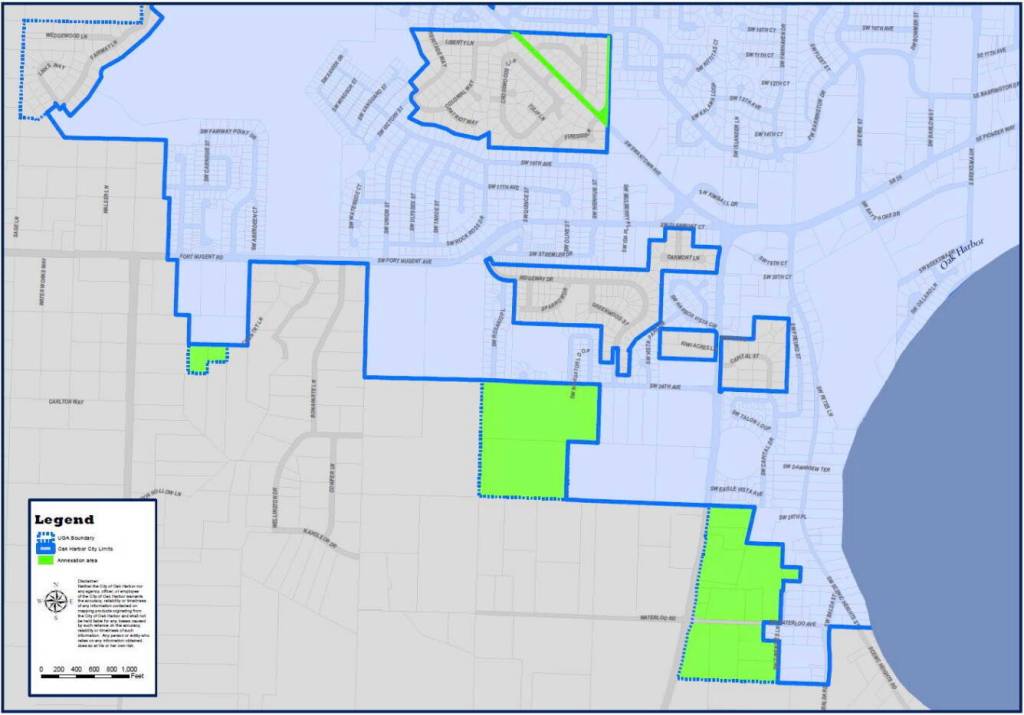
The city of Oak Harbor grew by 80 acres this week, following the council’s adoption of an annexation tied to the comprehensive plan update process.
Yet an environmental group has pledged to challenge the legality of the annexation and the larger comprehensive plan update because of the unresolved issue of “donut holes” of unincorporated county land within the city boundaries.
Marnie Jackson, executive director of Whidbey Environmental Action Network, spoke during the council meeting last week, arguing that the city must annex these unincorporated enclaves before or at the same time as the annexation of the 80 acres of property on the outskirts of the city.
“State law is explicit,” she said. “RCW 36.70a.1103 requires urban growth to be located first in areas already characterized by urban development. The so-called donut hole neighborhoods, fully encircled by Oak Harbor at urban densities without city services, are exactly those areas. Annexing 80 greenfield acres before serving those communities inverts the sequence that the Growth Management Act requires.”
Jackson said Whidbey Environmental Action Network reserves the right to challenge the annexation before the Boundary Line Review Board and to petition the Growth Management Review Board once the city’s comprehensive plan update is finalized.
City and county officials, however, plan to resolve the donut holes through an interlocal agreement in coming years, with a county planner and commissioner recently suggested it could happen in the next 10 to 15 years. Planners and elected officials have agreed that the annexations are inevitable, whether it’s through a city-county plan or by necessity when septic or water systems fail in those areas.
The four unincorporated pockets are all developed, with residences using septic tanks and wells. As council members pointed out during the meeting, the residents in these areas likely oppose annexation into the city because they don’t want to pay city utilities or city taxes. Also, connecting to city utilities can be very expensive.
The interlocal agreement may help determine how the connections and expansion of city infrastructure will be funded.
There’s widespread agreement that the enclaves represent a serious problem. During the meeting last week, council members each said that they wanted the donut holes to be annexed at some point.
Island County commissioners have repeatedly brought up the concern. During a meeting with the city council last month, Commissioner Melanie Bacon said she hates the donut holes and urged city officials to work with the county on resolving the issue.
The donut holes of land were even brought up during a Langley City Council meeting. Councilmember Craig Cyr asked Island County Long-Range Planner Emily Carr whether the issue in Oak Harbor was resolved. She said it had not, but she discussed how the interlocal agreement will tackle the problem.
“It’s not something we are forgetting about,” she said. “Those pockets are extremely developed neighborhoods that will have a lot of pushback when we tell them they will be annexed into the city as they will have to be connected to city services within 10 years.”
She added that planners will be working with the residents in these areas as part of the interlocal agreement to find solutions so they don’t experience “sticker shock.”
Bacon also attended the Langley meeting and emphasized the commissioners bring up the issue every time they meet with Oak Harbor officials.
“We were really, really clear that our expectation is that, in this interlocal agreement, they are going to resolve that donut hole problem,” she said. “It really does affect all of us.”
During the Oak Harbor council meeting, Councilmember Eric Marshall questioned why the donut holes weren’t just added to the current annexation, which would avoid the cost of potential litigation. He pointed out that properties in either the 80 acres or the donut holes wouldn’t have to hook into city services right away — that would only happen with new development or if infrastructure fails.
“It seems like the same rules apply, and the services are already there,” he said.
Marshall added that the unincorporated areas don’t just create infrastructure problems, but public safety concerns as well. He pointed out that the sheriff’s office and North Whidbey Fire and Rescue are currently responsible for those areas and have to travel through the city to reach them.
City Senior Planner Cac Kamak said it’s a timing issue. He explained that the process of extending services to already-developed areas is difficult and complex and that an overall plan is necessary. He gave the example of a property in the middle of an undeveloped area with a failing septic system. He asked whether it would make sense to extend the city’s sewer system to just the one property — past other properties — and questioned who would pay for it.
Creating the interlocal agreement will resolve those questions, Kamak said, but will take some time. He said the city needs to move forward with the 80-acre annexation now since it’s part of the comprehensive amendment process, and the update is due soon. The annexation is a necessary part of the comp plan update because the city has to show it can accommodate population growth over the 20-year horizon, he explained.
Under the ordinance, the annexation became valid five days after the meeting.